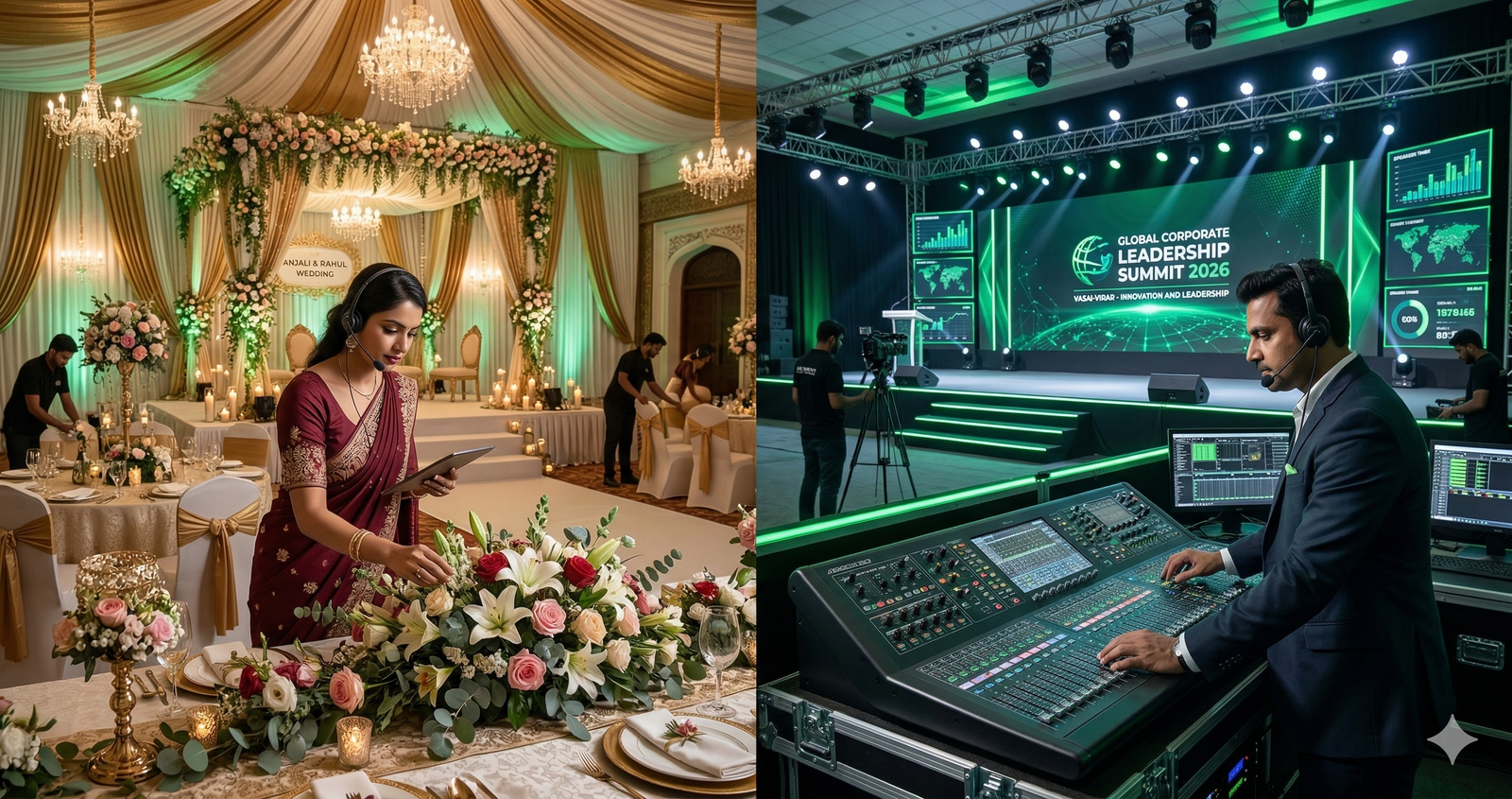
You have been planning weddings for years. You know how to manage emotional families, coordinate dozens of vendors, and execute multi-day celebrations flawlessly. Now you want to move into corporate events - better margins, more predictable timelines, and less emotional drama.
The good news: wedding planners already have 70% of the skills needed for corporate events. The challenge is adapting your approach, repositioning your brand, and landing that first corporate client.
This guide breaks down exactly what changes, what stays the same, and how to make the transition without abandoning the wedding business that pays your bills today.
Key Differences: Weddings vs Corporate Events
Before making any moves, you need to understand the fundamental differences between the two worlds. The table below compares the core aspects side by side.
| Aspect | Weddings | Corporate Events |
|---|---|---|
| Client | Family (emotional, personal) | Company (professional, ROI-focused) |
| Decision-making | Multiple family opinions | One point of contact (usually) |
| Timeline | 3 to 12 months | 2 weeks to 3 months |
| Budget transparency | Often vague | Clear, documented, approval-based |
| Payment | Cash + bank transfer, often advance-heavy | Invoice + 30 to 60 day payment cycles |
| Success metric | "Everyone had a great time" | Measurable ROI - attendance, leads, feedback scores |
| Repeat business | Rare (people marry once) | High (annual conferences, quarterly meetings) |
| Aesthetic | Lavish, decorative, emotional | Clean, branded, professional |
| Working hours | Late nights, multi-day | Typically 9 AM to 7 PM, single day |
The biggest mindset shift is this: wedding clients want an emotional experience. Corporate clients want business results. Every decision you make in corporate events needs to connect back to a measurable objective.
Skills You Already Have (That Corporates Value)
Do not underestimate what wedding planning has already taught you. These five skills transfer directly and are highly valued in the corporate event space:
- Vendor management - You have coordinated caterers, decorators, and AV vendors for years. Corporate events use the same vendor ecosystem, just with different briefs.
- Budget management - Wedding budgets are often larger than corporate event budgets. If you can manage a 50 lakh wedding budget with 30 vendors, a 10 lakh corporate event is well within your capability.
- Crisis handling - If you have survived a wedding day with three family arguments and a monsoon downpour, a corporate event where the projector stops working feels manageable.
- Attention to detail - Place cards, seating arrangements, timing sequences - wedding planners are masters of detail. Corporate clients notice and appreciate this precision.
- Client management - Managing a bride's family is, frankly, harder than managing a marketing manager. You already have the patience and diplomacy skills that corporate work requires.
Skills You Need to Develop
1. Understanding Corporate Objectives
Wedding goal: "Make it beautiful and memorable."
Corporate goal: "Generate 200 qualified leads" or "Increase employee engagement scores by 15%."
You need to think in terms of business outcomes, not just aesthetics. When you meet a corporate client for the first time, ask these questions:
- What does success look like for this event?
- How will you measure ROI?
- What is the key message you want attendees to take away?
- Who is the primary audience, and what action do you want them to take after the event?
These questions immediately signal that you understand corporate priorities. Most wedding planners who try corporate events fail at this step because they focus on decor and food instead of asking about outcomes.
2. Professional Communication
Corporate clients communicate differently. You will need to adapt your communication style significantly:
- Emails with clear subject lines - not WhatsApp voice notes at 11 PM
- Formal proposals with itemised budgets - not verbal quotes or rough estimates over a phone call
- Post-event reports with data - not just a photo album and a thank-you message
- Presentation skills - you may need to pitch to a room of 5 to 10 executives who will challenge your ideas and ask tough questions about ROI
Pro tip: Create a professional proposal template with your branding, a structured budget format, and a timeline visualisation. This one document will set you apart from 90% of wedding planners trying to enter the corporate space.
3. AV and Technology
Corporate events are tech-heavy compared to weddings. You will encounter these requirements regularly:
- Presentations, video playback, and live streaming setups
- Registration systems and badge printing
- Event apps for agendas, networking, and real-time polling
- Hybrid and virtual event platforms for remote attendees
- LED walls with corporate branding, often with strict colour accuracy requirements
You do not need to become a technical expert, but you must understand what each technology does, what it costs, and what can go wrong. Spend time with your AV vendors during setups. Ask questions. Within six months of active learning, you will be comfortable specifying AV requirements for any corporate brief.
4. Content and Programming
Corporate events have structured agendas that go far beyond "dinner, dance, and DJ." You will need to understand:
- Keynote speakers, panel discussions, and breakout sessions
- Workshop facilitation and interactive formats
- Networking sessions with structured activities (not just "mingle over drinks")
- Awards and recognition ceremonies with scripted flows
- Time management across multiple parallel tracks
5. Brand Compliance
Corporate clients have strict brand guidelines that you must follow precisely:
- Specific colours, fonts, and logo usage rules (often documented in a 50+ page brand book)
- Approved messaging and taglines - you cannot improvise here
- Compliance with industry regulations (especially for pharma, finance, and government events)
- No creative freedom beyond the brand playbook
This is perhaps the biggest culture shock for wedding planners. In weddings, creativity is your superpower. In corporate events, consistency with brand guidelines is what clients value most.
Adapting Your Portfolio
Your wedding portfolio will not land you a corporate client. You need to restructure how you present your work.
What to Remove
- Lavish decor photos with no corporate relevance
- Family-focused testimonials ("They made our daughter's wedding magical")
- Wedding-specific services (mehendi, sangeet, baraat coordination)
What to Add
- Clean, professional event setups - stage designs, branded backdrops, conference layouts
- Corporate branding and stage design examples
- Conference and seminar photos showing audience engagement
- Behind-the-scenes operational shots that demonstrate your process and professionalism
- Data-driven case studies with metrics ("Managed a 500-person conference with 94% attendee satisfaction")
If You Do Not Have Corporate Photos Yet
This is the catch-22 every wedding planner faces. Here are three practical solutions:
- Repackage your best wedding work: Pick 3 to 5 of your most professional-looking weddings and present them as "portfolio pieces" focusing on the stage, AV setup, and operational aspects rather than emotional moments
- Do 1 to 2 corporate events at reduced rates to build your portfolio. Approach this as a marketing investment, not a discount.
- Create mock setups: Set up a conference-style stage, a branded registration desk, or a networking zone, and photograph them professionally. This costs very little but gives you tangible corporate visuals to show potential clients.
Pricing Adjustments
Wedding pricing and corporate pricing work on fundamentally different models.
Wedding model: Package pricing or a percentage of the total budget. Payments are typically advance-heavy with cash components.
Corporate model: Itemised quotation with GST, formal invoicing, purchase order-based payment, and 30 to 60 day payment cycles after the event.
To operate in the corporate world, you will likely need to:
- Register for GST if you have not already
- Set up proper invoicing (Zoho Invoice, Tally, or similar accounting software)
- Accept 30 to 60 day payment terms (corporate finance departments work on fixed cycles)
- Build working capital to cover the payment gap between your vendor payments and client payments
Rate comparison to keep in mind:
- Wedding management fee: typically 15 to 25% of total budget
- Corporate management fee: typically 15 to 20% of total budget (slightly lower percentage, but with significantly higher repeat business potential)
The repeat business factor is the real advantage. A single corporate client can give you 4 to 8 events per year, compared to a wedding client who gives you one event and never returns.
Landing Your First Corporate Client
Step 1: Rebrand (Partially)
You do not need to abandon weddings. Instead, create a separate corporate identity:
- A separate service page or section on your website dedicated to corporate events
- A separate Instagram highlight or dedicated LinkedIn page for corporate work
- Update your LinkedIn headline to include "Corporate Events" alongside weddings
- Create a one-page corporate capabilities document you can email to prospects
Step 2: Leverage Your Wedding Network
Your wedding clients work at companies. This is your most overlooked asset:
- The bride who works at Infosys - a potential corporate event lead for their team offsites
- The groom's father who runs a manufacturing company - a dealer meet or product launch opportunity
- The wedding photographer - they also shoot corporate events and can refer you to their corporate clients
- The hotel where you have done multiple weddings - they host corporate events too and can recommend you to organisers
Send a simple message to your top 20 past wedding clients: "We have expanded into corporate events. If your company ever needs event planning support for conferences, offsites, or product launches, I would love to help." You will be surprised how many respond.
Step 3: Target Mid-Size Companies
Do not start by pitching to TCS or Reliance. They have established agency relationships and complex procurement processes. Instead, target:
- Startups planning their first offsite (50 to 100 people)
- SMEs doing annual dealer meets or team events
- Local businesses launching new products
- Coworking spaces hosting community events
- Professional associations organising annual conferences
These companies often do not have a preferred agency and are open to working with someone who demonstrates capability and enthusiasm.
Step 4: Offer a Pilot Event
"Let us manage your next team event at a special introductory rate. If you are happy, we will discuss a longer-term arrangement."
This removes the risk for the corporate client and gets your foot in the door. Deliver exceptionally on this one event, document everything (photos, feedback, metrics), and use it as your first proper corporate case study.
The Transition Timeline
Here is a realistic 12-month plan for making the shift:
Month 1 to 2: Research the corporate event industry. Study what corporate events look like in your city. Update your portfolio. Join LinkedIn groups focused on corporate events and HR professionals. Read industry publications.
Month 3 to 4: Reach out to 20 potential corporate leads from your existing network. Attend 2 to 3 business networking events (BNI meetings, chamber of commerce events, startup meetups). Build relationships before pitching.
Month 5 to 6: Land and execute your first 1 to 2 corporate events. Even small ones count. Document everything meticulously for your portfolio and case studies.
Month 7 to 12: Build corporate case studies with real data. Ask for referrals from satisfied corporate clients. Expand your corporate client base through targeted outreach and LinkedIn content.
Realistic expectation: Within 6 to 12 months, corporate events can make up 30 to 50% of your revenue, with weddings continuing to be your primary income while you build the corporate side. This is not an overnight transformation. It is a gradual, strategic diversification of your business.
The Bottom Line
The transition from weddings to corporate events is not a leap. It is a bridge. You are not starting over; you are expanding your skills and market reach.
The wedding industry taught you everything you need to know about managing chaos, people, and deadlines. Corporate events simply need you to apply those skills in a more structured, data-driven, business-focused way.
Start small. Rebrand partially. Leverage your existing network. Deliver one great corporate event, and the referrals will follow.
Building your career in events? Read our guide on freelancing in the Indian event industry for practical advice on going independent, and explore our complete event industry careers guide for role-by-role breakdowns, salary insights, and growth paths.
Want to share your transition story or expertise with India's event community? Get featured on EventSphereX - we are always looking for experienced professionals to contribute insights and practical advice that helps the industry grow.