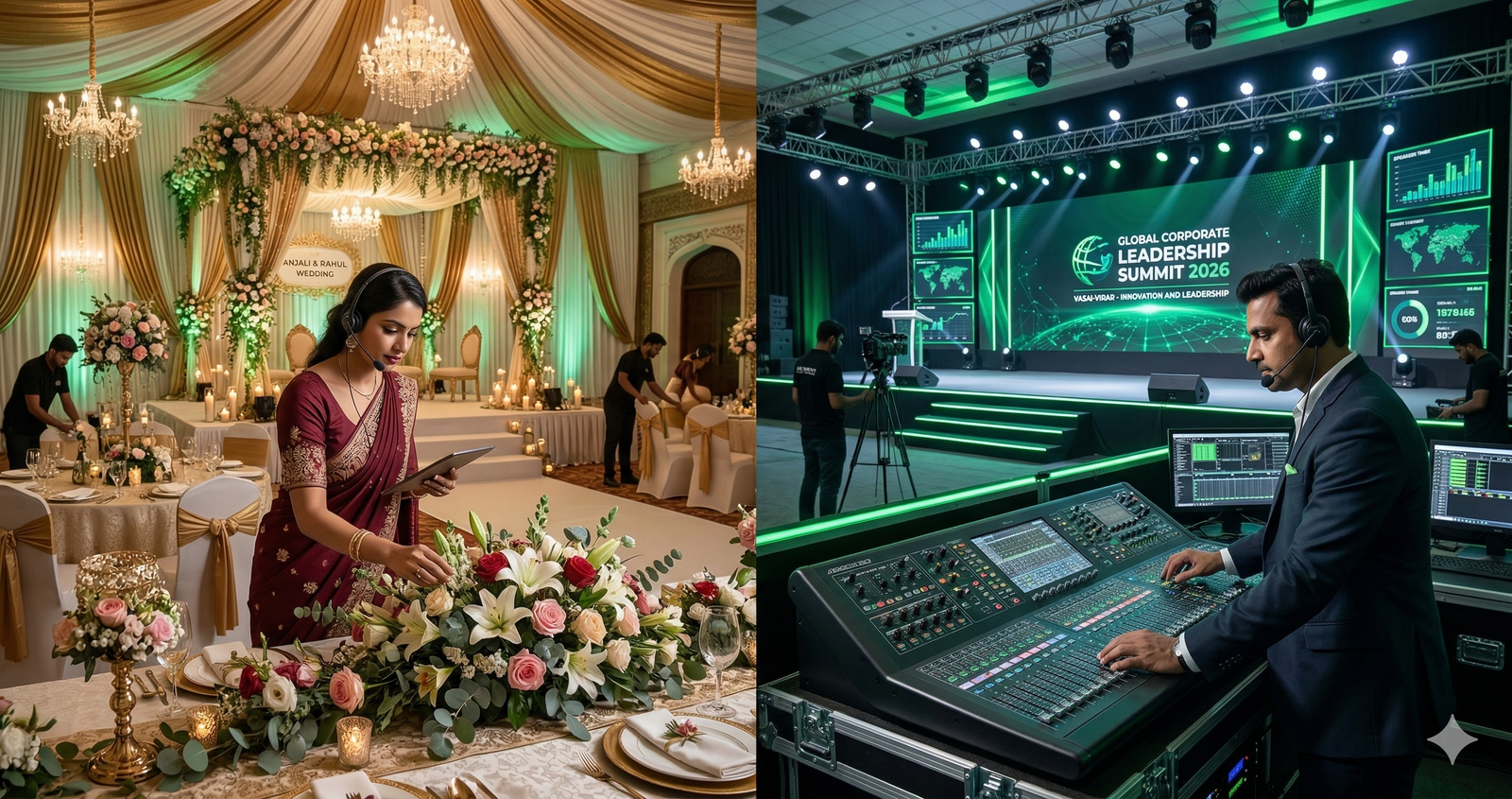
You have been planning weddings for years. You know how to manage emotional families, coordinate dozens of vendors, and execute multi-day celebrations flawlessly. Now you want to move into corporate events - better margins, more predictable timelines, and less emotional drama.
The good news: wedding planners already have 70% of the skills needed for corporate events. The challenge is adapting your approach, repositioning your brand, and landing that first corporate client.
Key Differences: Weddings vs Corporate Events
| Aspect | Weddings | Corporate Events |
|---|---|---|
| Client | Family (emotional, personal) | Company (professional, ROI-focused) |
| Decision-making | Multiple family opinions | One point of contact (usually) |
| Timeline | 3 to 12 months | 2 weeks to 3 months |
| Budget transparency | Often vague | Clear, documented, approval-based |
| Payment | Cash + bank transfer, advance-heavy | Invoice + 30 to 60 day payment cycles |
| Success metric | "Everyone had a great time" | Measurable ROI - attendance, leads, feedback scores |
| Repeat business | Rare (people marry once) | High (annual conferences, quarterly meetings) |
| Aesthetic | Lavish, decorative, emotional | Clean, branded, professional |
| Working hours | Late nights, multi-day | Typically 9 AM to 7 PM, single day |
Skills You Already Have (That Corporates Value)
- Vendor management - You have coordinated caterers, decorators, and AV vendors for years
- Budget management - Wedding budgets are often larger than corporate event budgets
- Crisis handling - If you have survived a wedding day with 3 family arguments and a monsoon, a corporate event feels manageable
- Attention to detail - Place cards, seating arrangements, timing - wedding planners are masters of detail
- Client management - Managing a bride's family is harder than managing a marketing manager
Skills You Need to Develop
1. Understanding Corporate Objectives
Wedding goal: "Make it beautiful and memorable." Corporate goal: "Generate 200 qualified leads" or "Increase employee engagement scores by 15%."
You need to think in terms of business outcomes, not just aesthetics. Ask clients:
- What does success look like for this event?
- How will you measure ROI?
- What is the key message you want attendees to take away?
2. Professional Communication
Corporate clients communicate differently:
- Emails with clear subject lines (not WhatsApp voice notes)
- Formal proposals with itemised budgets (not verbal quotes)
- Post-event reports with data (not just a photo album)
- Presentation skills - you may need to pitch to a room of 5 executives
3. AV and Technology
Corporate events are tech-heavy:
- Presentations, video playback, live streaming
- Registration systems and badge printing
- Event apps for agendas and networking
- Hybrid/virtual event platforms
- LED walls with corporate branding
4. Content and Programming
Corporate events have structured agendas:
- Keynote speakers, panel discussions, breakout sessions
- Workshop facilitation and interactive formats
- Networking sessions with structured activities
- Awards and recognition ceremonies
5. Brand Compliance
Corporate clients have strict brand guidelines:
- Specific colours, fonts, and logo usage rules
- Approved messaging and taglines
- Compliance with industry regulations
- No creative freedom beyond the brand playbook
Adapting Your Portfolio
What to Remove
- Lavish decor photos with no corporate relevance
- Family-focused testimonials
- Wedding-specific services (mehendi, sangeet, baraat)
What to Add
- Clean, professional event setups
- Corporate branding and stage design
- Conference and seminar photos
- Behind-the-scenes operational shots
- Data-driven case studies
If You Don't Have Corporate Photos Yet
- Redesign 3 to 5 of your most professional-looking weddings as "portfolio pieces" - focus on the stage, AV setup, and operational aspects rather than emotional moments
- Do 1 to 2 corporate events at reduced rates to build your portfolio
- Create mock setups - a conference-style stage, branded registration desk - and photograph them professionally
Pricing Adjustments
Wedding pricing and corporate pricing work differently:
Wedding model: Package pricing or percentage of total budget Corporate model: Itemised quotation with GST, formal invoicing, PO-based payment
You will likely need to:
- Register for GST (if not already)
- Set up proper invoicing (Zoho Invoice, Tally)
- Accept 30 to 60 day payment terms (corporate finance cycles)
- Build working capital to cover the payment gap
Rate comparison:
- Your wedding management fee: 15 to 25% of budget
- Corporate management fee: 15 to 20% of budget (slightly lower, but with repeat business potential)
Landing Your First Corporate Client
Step 1: Rebrand (Partially)
You do not need to abandon weddings. Create a separate service page or section:
- "Your Company Name - Corporate Events Division"
- Separate Instagram highlight or LinkedIn page for corporate work
- Update your LinkedIn headline to include "Corporate Events"
Step 2: Leverage Your Wedding Network
Your wedding clients work at companies:
- The bride who works at Infosys - potential corporate event lead
- The groom's father who runs a manufacturing company - dealer meet opportunity
- The wedding photographer - they also shoot corporate events and can refer you
Step 3: Target Mid-Size Companies
Do not start by pitching to TCS or Reliance. Target:
- Startups planning their first offsite (50 to 100 people)
- SMEs doing annual dealer meets or team events
- Local businesses launching new products
- Coworking spaces hosting community events
Step 4: Offer a Pilot Event
"Let us manage your next team event at a special introductory rate. If you are happy, we will discuss a longer-term arrangement."
This removes the risk for the corporate client and gets your foot in the door.
The Transition Timeline
Month 1 to 2: Research corporate event industry, update portfolio, join LinkedIn corporate groups Month 3 to 4: Reach out to 20 potential corporate leads, attend 2 business networking events Month 5 to 6: Land and execute your first 1 to 2 corporate events Month 7 to 12: Build corporate case studies, ask for referrals, expand corporate client base
Realistic expectation: Within 6 to 12 months, corporate events can make up 30 to 50% of your revenue, with weddings continuing to be your primary income while you build the corporate side.
The transition from weddings to corporate events is not a leap - it is a bridge. You are not starting over; you are expanding your skills and market. The wedding industry taught you everything you need to know about managing chaos, people, and deadlines. Corporate events just need you to apply those skills in a more structured, business-focused way.
Read our guide on freelancing in India's event industry for practical advice on going independent, and explore our complete event industry careers guide for role-by-role breakdowns, salary insights, and growth paths.