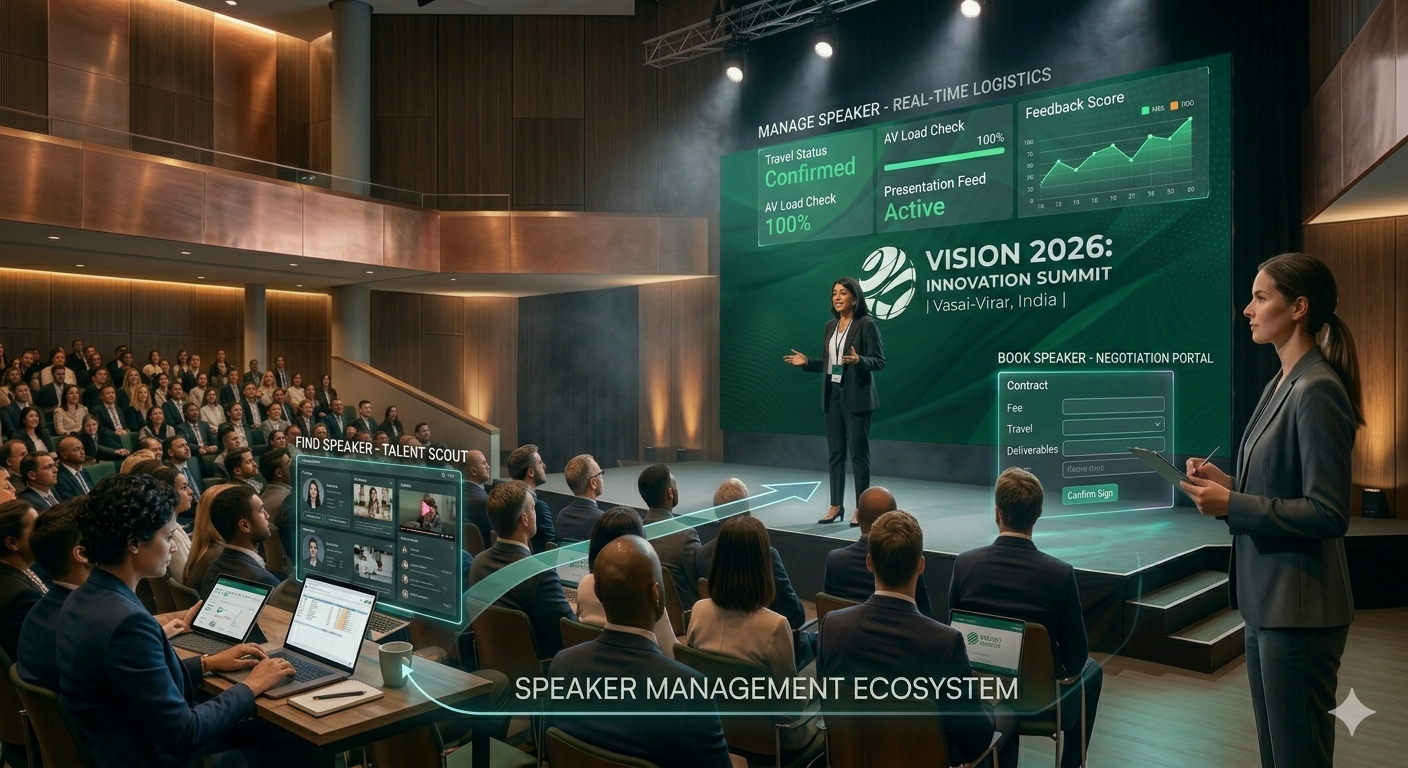
Conference speaker management comes down to three pillars: sourcing the right voice for your audience, handling logistics so nothing falls through the cracks, and creating an experience that makes the speaker want to come back. Get all three right and your conference content becomes the reason people buy tickets. Get any one wrong and your headline act becomes your headline disaster.
This guide covers every stage of the speaker management lifecycle - from the first outreach email to the post-event thank-you - with fee benchmarks, contract templates, and coordination checklists used by conference organisers managing 5 to 500 speakers annually.
The Three Pillars of Speaker Management
Before diving into tactics, understand the framework that separates amateur conferences from professionally run events:
- Sourcing - Finding speakers who match your audience, topic, and budget
- Logistics - Contracts, travel, technical riders, rehearsals, and payments
- Experience - Green room, stage management, transitions, and post-event relationship building
Every decision you make should serve one of these three pillars. If an action does not improve sourcing quality, logistical reliability, or speaker experience, it is probably not worth your time.
Where to Find Conference Speakers
The best speakers are rarely found through a single channel. Professional conference organisers use a layered sourcing strategy.
Speaker Bureaus
Speaker bureaus act as talent agencies for professional speakers. They handle fee negotiation, contracts, and logistics for a commission (typically 20-30% of the speaker fee, paid by the speaker).
Global bureaus worth knowing:
- Washington Speakers Bureau (WSB) - top-tier political, business, and celebrity speakers
- Harry Walker Agency - strong in thought leadership and former heads of state
- Leading Authorities - mid-tier to premium speakers across industries
- Chartwell Speakers - UK and European market focus
- Speakers Associates - global roster with strong APAC coverage
India-focused bureaus and platforms:
- SpeakIn - India's largest speaker platform with 15,000+ profiles
- Black Hat Speakers - corporate and motivational speakers for Indian events
- Celebrity Management India - Bollywood, sports, and business celebrity speakers
- JEEVANSATHI Speakers Bureau - government, bureaucrat, and policy speakers
Direct Sourcing Channels
| Channel | Best For | Effort Level | Cost |
|---|---|---|---|
| LinkedIn search | Industry experts, CXOs | Medium | Free |
| TED/TEDx talk archives | Proven stage performers | Low | Free to research |
| Industry association directories | Niche domain experts | Medium | Free |
| Past event video archives (YouTube) | Evaluating speaking ability | Low | Free |
| Academic conference proceedings | Research-backed speakers | High | Free |
| Podcast guest lists | Articulate communicators | Medium | Free |
| SpeakerHub / Sessionize | Emerging speakers | Low | Free platform |
| Author databases (Amazon, Goodreads) | Published thought leaders | Medium | Free |
| Competitor event programmes | Proven conference speakers | Low | Free |
The "Speaker Tree" Method
One of the most effective sourcing techniques is the speaker tree. Start with one confirmed speaker and ask them: "Who else should be on this stage?" Speakers know other speakers. A single introduction from a confirmed headliner carries more weight than a cold email from an unknown organiser.
This method works especially well for panel curation, where you need 3-4 speakers with complementary perspectives on the same topic.
Speaker Fee Benchmarks
Speaker fees vary enormously based on profile, geography, event type, and negotiation skill. These benchmarks reflect 2025-2026 market rates.
Global Fee Ranges (USD)
| Speaker Category | Fee Range (USD) | Typical Booking Lead Time |
|---|---|---|
| Emerging/local expert | $1,000 - $5,000 | 2-4 weeks |
| Published author (mid-list) | $5,000 - $15,000 | 4-8 weeks |
| Industry C-suite (active) | $10,000 - $30,000 | 6-12 weeks |
| TEDx speaker (popular talk) | $7,500 - $25,000 | 4-8 weeks |
| TED main stage speaker | $25,000 - $75,000 | 8-16 weeks |
| Celebrity CEO / tech founder | $50,000 - $150,000 | 12-24 weeks |
| Motivational speaker (top tier) | $30,000 - $100,000 | 8-16 weeks |
| Former head of state / global leader | $100,000 - $500,000+ | 16-52 weeks |
| A-list celebrity | $200,000 - $1,000,000+ | 16-52 weeks |
India Fee Ranges (INR)
| Speaker Category | Fee Range (INR) | Notes |
|---|---|---|
| Domain expert / consultant | INR 50,000 - 2,00,000 | Often negotiable for exposure |
| Startup founder (funded) | INR 1,00,000 - 5,00,000 | Some speak free for brand building |
| Corporate CXO (active) | INR 2,00,000 - 10,00,000 | Company may cover or restrict |
| Published author (Indian) | INR 1,50,000 - 8,00,000 | Book sales opportunity matters |
| Bollywood celebrity | INR 25,00,000 - 2,00,00,000 | Plus entourage and rider costs |
| Cricket / sports personality | INR 15,00,000 - 1,50,00,000 | IPL season availability is tight |
| Government minister / bureaucrat | INR 0 - 5,00,000 | Protocol-heavy, free for govt events |
| Motivational speaker (Indian circuit) | INR 3,00,000 - 15,00,000 | High demand for Hindi-English mix |
| International speaker (flying in) | INR 10,00,000 - 50,00,000+ | Plus business class flights and hotel |
Important note on Indian government speakers: IAS/IPS officers and sitting ministers typically do not charge speaker fees for official events. However, protocol requirements (security, specific vehicle arrangements, seating hierarchy) can add INR 1-3 lakh in logistics costs.
Fee Negotiation Strategies
Speaker fees are almost always negotiable, especially for non-celebrity speakers. Here are proven negotiation levers:
What You Can Offer Beyond Cash
- Video rights - Professional recording of their talk, edited and delivered within 2 weeks
- Audience access - Direct access to your attendee list (with consent) for their mailing list or book sales
- Book sales table - Space to sell and sign books at the venue
- Media coverage - Guaranteed press mentions, photographer coverage, social media promotion
- Future bookings - Multi-event deals at reduced per-event rates
- Speaking reel - Multi-camera professional footage they can use on their website
- Travel upgrade - Business class vs economy can sometimes replace a fee increase
Negotiation Tactics That Work
- Anchor with your budget, not their rate card. "Our speaker budget for this slot is $X" is stronger than "What is your fee?"
- Bundle multiple speakers from the same bureau. Bureaus will discount 10-15% for 3+ bookings.
- Offer early commitment. Speakers booked 6+ months out are more flexible on fees than those booked 6 weeks out.
- Leverage the cause. Non-profit, educational, or industry-development events can legitimately ask for reduced rates.
- Propose a hybrid deal. Half cash fee plus video rights, plus a sponsored dinner, plus a feature article on your platform.
Use the EventSphereX Budget Calculator to model different speaker fee scenarios against your total event budget before you start negotiations.
Speaker Contract Essentials
Never book a speaker on a handshake. Even for free speakers, a written agreement protects both parties.
Must-Have Contract Clauses
- Fee and payment terms - Amount, currency, deposit percentage (typically 50% on signing), balance due date (typically 14 days before event or 7 days after)
- Cancellation terms - Who pays what if either party cancels, with tiered penalties based on notice period
- Scope of engagement - Exact session type (keynote, panel, fireside chat, workshop), duration, and whether Q&A is included
- Exclusivity window - Whether the speaker agrees not to speak at competing events within a defined period (30-90 days is standard)
- Content ownership - Who owns the presentation content, recording rights, and distribution rights
- Travel and accommodation - Exactly what is covered (class of travel, hotel star rating, number of nights)
- Technical rider - Detailed AV requirements attached as an appendix
- Force majeure - What happens if the event is cancelled due to circumstances beyond control
- Substitution clause - Whether the speaker can send a replacement, and your right to approve
- Confidentiality - Whether the fee amount is confidential (most speakers and bureaus require this)
Red Flags in Speaker Contracts
Watch out for these in contracts sent by speaker bureaus:
- Unlimited cancellation penalties (should be capped at the fee amount)
- No substitution approval right (you should always have veto power)
- Blanket recording prohibition (negotiate at least internal-use rights)
- Fee payable regardless of attendance (tie at least part of the fee to the speaker actually showing up)
Technical Rider Management
The technical rider is the document that specifies exactly what the speaker needs on stage. Managing this well is the difference between a smooth session and a technical disaster.
Standard Technical Rider Elements
Presentation setup:
- Laptop compatibility (Mac/PC, own laptop vs venue laptop)
- Presentation software and version (PowerPoint, Keynote, Google Slides, Prezi)
- Screen resolution and aspect ratio (16:9 vs 4:3 - always confirm)
- Slide advancer/clicker preference (most speakers bring their own)
- Confidence monitor (showing current and next slide)
Audio requirements:
- Microphone type (lapel/lavalier, handheld, headset, podium)
- Audio playback from presentation (requires separate audio feed from laptop)
- In-ear monitor for panel discussions
Stage requirements:
- Podium vs open stage preference
- Stage lighting (some speakers require specific lighting for skin tone on camera)
- Water on stage (still, room temperature - nearly universal requirement)
- Timer/clock visible to speaker (countdown display)
For a complete breakdown of AV setups for events, read our Complete AV Setup Guide.
Rider Management Checklist
- Request technical rider at contract signing (not 2 days before the event)
- Share rider with your AV vendor within 48 hours of receiving it
- Flag any requirements your venue cannot meet immediately
- Confirm all rider items in writing 2 weeks before the event
- Do a technical run-through 24 hours before the event (or morning-of at minimum)
- Have backup equipment for every critical item (spare clicker, spare lapel mic, spare laptop with presentations loaded)
Travel and Hospitality Management
Speaker travel logistics are where most organisers underestimate the work involved.
Travel Booking Best Practices
- Book flights yourself rather than reimbursing. This gives you control over timing and cost.
- Build in buffer days. For international speakers, arrive the day before. For domestic speakers at morning sessions, arrive the evening before.
- Share a detailed travel brief including airport pickup details, driver contact, hotel confirmation, and venue address with Google Maps link.
- Keep a travel contingency fund of 10-15% of total speaker travel budget for last-minute changes.
Hotel and Hospitality Standards
| Speaker Tier | Hotel Standard | Room Type | Extra Amenities |
|---|---|---|---|
| Emerging/local | 4-star | Standard | Welcome note |
| Mid-tier professional | 4-5 star | Deluxe/Executive | Welcome hamper, late checkout |
| Premium/celebrity | 5-star | Suite | Personal liaison, car service, security |
| Government/VIP (India) | 5-star / Government guest house | Suite | Protocol officer, advance security recce |
The Welcome Kit
A small gesture that makes a disproportionate impact. Include in the hotel room before arrival:
- Personalised welcome letter from the organiser
- Event schedule with their sessions highlighted
- Venue map with green room and stage locations marked
- Local SIM card (for international speakers)
- Bottle of water, local snacks, and a small gift (book, local craft item)
- Emergency contact card with organiser's mobile number
Pre-Event Speaker Preparation
The preparation phase is where you turn a good speaker into a great session.
Content Review and Alignment
- Share your audience profile 4-6 weeks before the event. Include demographics, job titles, knowledge level, and what they expect to learn.
- Request a presentation draft 2-3 weeks before for review. You are not editing their content - you are checking for brand alignment, time fit, and overlap with other sessions.
- Flag content overlaps between speakers early. Nothing kills a multi-speaker conference faster than three keynotes making the same points.
- Provide a content brief that includes 3-5 key questions the audience wants answered. Let the speaker shape their talk around real audience needs.
Rehearsals and Timing
- Full technical rehearsal the day before or morning of the event
- Timing run to confirm the talk fits the allocated slot (a "45-minute keynote" from a speaker who has never timed it often runs 65 minutes)
- AV check with the actual presentation file on the actual equipment
- Stage walk so the speaker knows sight lines, screen positions, and stage boundaries
Briefing Document
Send every speaker a single-page briefing document 1 week before the event:
- Session title, date, time, and duration
- Room name and capacity
- Expected audience size and profile
- Other speakers on the same stage (for panels)
- Green room location and opening time
- AV contact name and mobile number
- Social media hashtags and handles
- Post-session commitments (book signing, networking, media interviews)
Day-of Speaker Coordination
This is where execution matters more than planning.
Green Room Management
The green room is the speaker's backstage home. Get it right:
- Location: Within 2 minutes walking distance of the stage
- Setup: Comfortable seating, full-length mirror, good lighting, power outlets, strong WiFi
- Catering: Water, tea, coffee, light snacks (ask dietary preferences in advance)
- Privacy: Separate from general attendee areas, no uninvited guests
- Tech station: Laptop with internet access for last-minute presentation edits
- Printed schedule: Wall-mounted schedule showing all sessions with timing
Stage Management and Transitions
- Assign a dedicated speaker liaison for every 3-4 speakers. This person is responsible for getting the speaker from green room to stage on time.
- Use a 15-minute warning system. Alert speakers at 15 minutes, 5 minutes, and 2 minutes before their slot.
- Stage transitions between speakers should take no more than 3 minutes. Pre-load presentations, pre-set microphones, pre-position water.
- Time signals during the talk. Use a visible countdown timer or agreed hand signals from the front row: 10 minutes remaining, 5 minutes, 1 minute, time's up.
Handling Speaker Emergencies
Have contingency plans for these common scenarios:
| Scenario | Response Protocol |
|---|---|
| Speaker cancels day-of | Backup speaker list, extend Q&A of adjacent session, or convert to moderated discussion |
| Presentation file corrupted | Keep cloud backup (Google Drive link), have USB copy, worst case: speaker talks without slides |
| Speaker runs over time | Stage manager gives hard cut signal, moderator steps in with "one final thought" prompt |
| Technical failure mid-talk | AV team switches to backup system, speaker continues without slides for 60 seconds max |
| Speaker arrives late | Swap session order, fill gap with networking break or sponsor segment |
Panel Discussion Management
Panels require different management than keynotes. A poorly managed panel is the most common source of audience complaints at conferences.
Panel Curation Rules
- Maximum 4 panellists plus 1 moderator. Five panellists means nobody gets enough speaking time.
- Diversity of perspective is mandatory. Four people who agree on everything makes for terrible viewing.
- At least one contrarian. The panellist who challenges consensus is the one the audience remembers.
- Never put direct competitors on the same panel unless the topic explicitly requires comparison.
Moderator Briefing
Your moderator is the most important person on a panel. Brief them on:
- Each panellist's background and likely positions
- 8-10 prepared questions (they will use 5-6)
- Audience interaction plan (when to take questions, how to manage them)
- Time allocation per question (typically 2 minutes per panellist response)
- How to handle a panellist who dominates (redirect by name to quieter panellists)
- Hard stop time and closing question
Pre-Panel Coordination Call
Schedule a 20-minute video call with all panellists 1 week before the event. Purpose:
- Introductions (panellists who know each other perform better)
- Share the question framework (not exact questions - you want spontaneity)
- Agree on no-go topics or sensitive areas
- Confirm technical setup (seated vs standing, individual mics, shared screen)
Virtual and Hybrid Speaker Management
Managing remote speakers requires a completely different logistics stack.
Technical Requirements for Remote Speakers
- Dedicated internet connection - minimum 10 Mbps upload speed, wired ethernet preferred
- Professional audio - external microphone mandatory, laptop built-in mic is not acceptable for conference-quality audio
- Camera setup - webcam at eye level, well-lit face (ring light or window light), neutral background
- Backup connection - mobile hotspot ready as failover
- Platform rehearsal - full technical run on the actual streaming platform 48-72 hours before
Hybrid Stage Integration
The biggest mistake in hybrid events is treating the remote speaker as a secondary participant. Best practices:
- Display the remote speaker on a screen that is the same size as the physical stage backdrop
- Use a dedicated camera pointed at the audience so the remote speaker can see reactions
- Assign a "virtual stage manager" whose only job is managing the remote speaker feed
- Build in 5-second delay buffers for audio latency in Q&A segments
- Have a physical moderator who bridges between in-room and remote speakers
For more on hybrid event execution, see our guide on Virtual and Hybrid Events.
Post-Event Speaker Management
The relationship does not end when the speaker leaves the stage.
Within 48 Hours
- Send a personalised thank-you email with 2-3 specific compliments about their talk
- Share audience feedback scores (if available)
- Provide the professional recording or photos for their use
- Process final payment (if balance was due post-event)
- Connect on LinkedIn (from the organiser's personal account, not a company page)
Within 2 Weeks
- Send the edited video with usage rights clearly stated
- Share social media posts featuring their session
- Provide a written testimonial they can use for future bookings
- Ask for feedback on their experience as a speaker at your event
Building the Long-Term Relationship
The best conferences are built on repeat relationships with speakers who become advocates for your event. Maintain a speaker database with:
- Contact details and bureau representation
- Fee history (what they charged you and when)
- Technical rider on file
- Performance ratings (audience scores, organiser notes)
- Availability patterns (seasons, geographies, topics)
- Relationship status (hot, warm, cold)
Speaker Management Tools and Templates
Recommended Software
| Tool | Purpose | Price Range |
|---|---|---|
| Sessionize | Speaker submissions and scheduling | Free - $500/event |
| SpeakerFlow | CRM for speaker management | $29 - $99/month |
| Swoogo | Full event management with speaker module | $5,000+/year |
| Google Sheets | Budget tracking, contact database | Free |
| Calendly | Scheduling rehearsals and briefing calls | Free - $12/month |
| Loom | Async video briefings for speakers | Free - $12.50/month |
Planning the full event budget? Use the EventSphereX Budget Calculator to allocate speaker costs against your total event spend.
Essential Templates Checklist
- Speaker outreach email template
- Speaker contract (with rider appendix)
- Travel briefing document
- Day-of briefing sheet
- Post-event feedback survey
- Speaker database spreadsheet
Need to create a professional event proposal that includes your speaker lineup? Our Event Proposal Guide walks through the complete process.
Frequently Asked Questions
1. How far in advance should I book conference speakers?
For keynote speakers and headliners, book 6-12 months in advance. For panel speakers and breakout session presenters, 3-6 months is usually sufficient. Celebrity and political speakers often require 12+ months of lead time. The earlier you book, the better your negotiating position on fees.
2. How much should I budget for conference speakers?
Speaker costs typically represent 15-30% of total conference budgets. For a mid-sized corporate conference (200-500 attendees), budget $15,000-50,000 USD (INR 12-40 lakh) for a speaker lineup of 1 keynote and 8-12 session speakers. Always add 10% contingency for travel overruns and last-minute changes.
3. Should I pay speakers for panel discussions?
Standard practice varies by market. In the US and Europe, panel speakers at industry conferences are often unpaid but receive travel coverage and event access. In India, panel speakers at corporate events typically receive INR 50,000-2,00,000 per panel plus travel. Always offer at minimum: travel reimbursement, accommodation, and professional photography.
4. How do I evaluate a speaker before booking them?
Watch at least 2-3 full recordings of their previous talks (not highlight reels). Check audience ratings on platforms like SpeakerHub. Ask for 3 references from previous event organisers. If possible, attend an event where they are speaking to see them live. Look for stage presence, audience engagement, and the ability to handle Q&A.
5. What happens if a confirmed speaker cancels last minute?
Your contract should include cancellation terms with tiered penalties. For day-of cancellations, have a backup plan: a pre-identified replacement speaker, an extended Q&A with a panel, or a moderated audience discussion. Always have 2-3 backup speakers on standby for your most critical sessions.
6. How do I handle a speaker who goes over their allotted time?
Prevention is better than cure. Conduct a timed rehearsal beforehand. On the day, use visible countdown timers and agree on time signals in advance. If a speaker is still running over, have your moderator or stage manager step in with a firm but respectful "Let's take one final question" prompt. Never cut audio abruptly.
7. Are speaker fees negotiable?
Almost always, especially for non-celebrity speakers. The most effective negotiation lever is offering value beyond cash: professional video recording, audience access, media coverage, or multi-event deals. Fees are least negotiable for speakers booked through major bureaus, though even bureaus will offer discounts for multiple bookings.
8. How do I manage speakers at a multi-track conference?
Assign a dedicated speaker coordinator for each track (1 coordinator per 4-6 speakers). Use a shared digital schedule (Google Calendar or Swoogo) that updates in real-time. Hold a daily 10-minute coordination standup between track coordinators. Ensure all speaker liaisons have walkie-talkies or a shared WhatsApp group for instant communication.
9. What should a speaker green room include?
At minimum: comfortable seating, power outlets, strong WiFi, water, tea/coffee, light snacks, a full-length mirror, and a printed schedule. For premium speakers, add a private space for phone calls, a dedicated tech station for last-minute presentation edits, and a personal liaison. The green room should be within 2 minutes walking distance of all stages.
10. How do I build a speaker database for future events?
Start with a spreadsheet tracking: speaker name, contact details, bureau representation, topics, fee range, performance rating, technical rider on file, and relationship notes. After each event, update with audience feedback scores and your own assessment. Over 2-3 years, this database becomes your most valuable conference planning asset. Consider tools like SpeakerFlow or a custom Airtable base for scaling beyond 100 speakers.
Conclusion
Speaker management is equal parts logistics, relationship building, and stage production. The organisers who do it well treat speakers as partners rather than vendors - investing in preparation, providing genuine hospitality, and building relationships that extend beyond a single event.
Start with the fundamentals - clear contracts, thorough technical riders, and reliable day-of coordination. As your conference grows, invest in the relationship layer: speaker databases, post-event engagement, and the reputation that makes top speakers want to speak at your event without being asked.
Ready to plan your conference budget? Use the EventSphereX Budget Calculator to model your full event spend, including speaker fees, travel, and production costs.