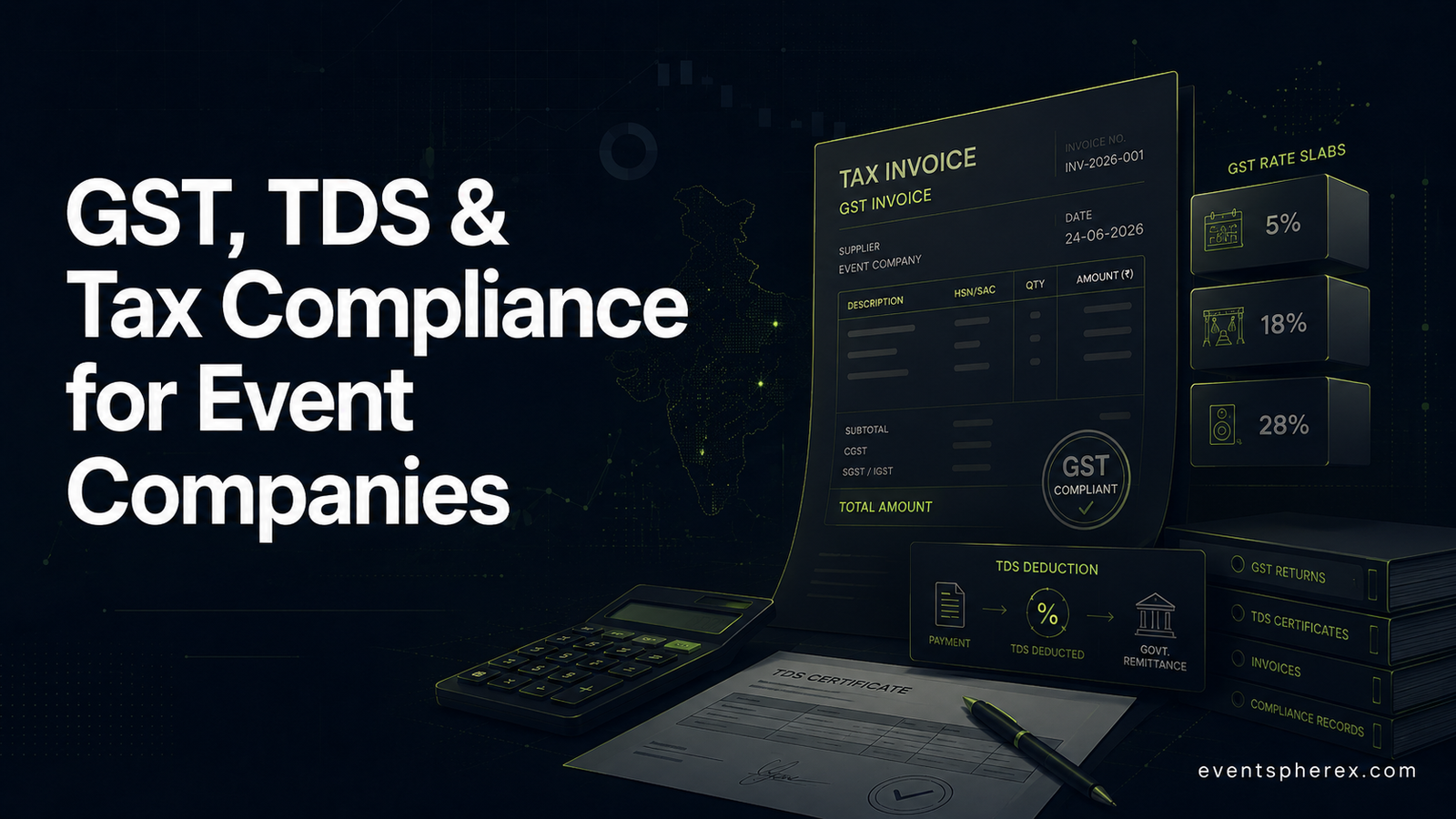
Why Event Companies Are Tax-Compliance Heavy
Most product businesses sell one thing at one rate from one state. Event companies do the opposite:
- They invoice bundled services (planning + decor + AV + catering + manpower) at one line item, but the underlying rates differ.
- They run events in states they aren't registered in, triggering inter-state place-of-supply questions.
- They pay freelancers, anchors, photographers, sound techs, and crew - every one of which is a TDS event.
- They receive sponsorship income, which is a reverse-charge category in many cases.
- They handle client F&B reimbursements and venue billings that cannot just be passed through without thought.
This is why two equally good event agencies can have wildly different P&Ls - the one that runs tax cleanly keeps 4-8 percentage points of margin that the other quietly loses to non-compliance, interest, and disallowed expenses.
GST Rates That Apply to Indian Event Services
The most common rates an event company touches in 2026:
| Service Category | Typical GST Rate | Notes |
|---|---|---|
| Event management services | 18% | Default rate for agency fee / planning |
| AV equipment rental | 18% | Pure rental |
| Decor & fabrication | 18% | Pure service |
| Outdoor catering at events | 5% (no ITC) or 18% (with ITC) | Depends on the route the caterer follows |
| Hotel banquet F&B (above Rs 7,500/night room) | 18% | Bundled with banquet hall |
| Hotel banquet F&B (below Rs 7,500/night room) | 5% | Different ITC treatment |
| Pure venue rental | 18% | If the venue is not a hotel |
| Sponsorship income (sponsor pays org) | RCM - sponsor pays GST | Critical to invoice correctly |
| Tickets - non-recognised sports / entertainment over Rs 500 | 28% | Movie tickets, certain entertainment |
| Tickets - most events <= Rs 500 | 18% | Most non-cinema event tickets |
Always confirm current rates with your CA - GST notifications change often, and 2025-26 saw multiple rationalisation changes.
Place of Supply: The Single Biggest Audit Risk
Here is where most event agencies get burned.
If your agency is registered in Maharashtra and you execute an event in Delhi for a client headquartered in Karnataka - what is the place of supply, and what tax do you charge?
The general rule for event services under GST: place of supply is the location where the event is held, when the service is provided to a registered person. For an event in Delhi, even if your office is in Mumbai and your client is in Bengaluru, the GST is treated as inter-state, and IGST applies - but you may need to register for GST in Delhi if you cross thresholds or take a casual taxable person registration for the event window.
Most agencies handle this in one of three ways:
- Take a casual taxable person (CTP) registration in the event state for the duration of the event.
- Bill from a registered branch in that state (only viable if you're already registered there).
- Get an "input service distributor" (ISD) structure if you are billing from one HQ but executing across states.
Pick a structure with your CA, and apply it consistently. The damage usually comes from inconsistency - billing some events one way, others a different way.
TDS: Both Sides of the Coin
When Your Agency is the Deductor
You will be deducting TDS when paying:
- Freelancers and professionals (anchors, photographers, designers) - Section 194J at 10%
- Contract labour / manpower vendors - Section 194C at 1% (individual/HUF) or 2% (company)
- Venue rentals - Section 194I at 10% (land/building) or 2% (plant & machinery)
- Performance artists and entertainers - typically 194J 10% or 194C 2% depending on contract structure
- Sponsorships you pay out - varies, often 194C
You must:
- Deduct at the time of credit or payment, whichever is earlier
- Deposit by the 7th of the next month (30 April for March deductions)
- File quarterly TDS returns (24Q, 26Q)
- Issue Form 16A to the deductee within 15 days of return filing
When Your Agency is the Deductee
Corporates paying you will deduct TDS - usually under 194C (1-2%) or 194J (10%) - depending on how they categorise event services. The TDS deducted shows up in your Form 26AS / AIS and is adjusted against your final tax liability.
Critical: Reconcile your 26AS / AIS every quarter. Most event agencies discover at year-end that 5-15% of their TDS credits are missing because clients deducted but didn't deposit, or deposited under the wrong PAN. By then, recovery is hard.
Sponsorship: The RCM Special Case
Sponsorship is one of the few service categories under GST where reverse charge applies. When a body corporate or partnership firm pays sponsorship to an event organiser, the sponsor pays the GST directly to the government - not to you.
This means:
- You raise an invoice without GST for sponsorship from a body corporate sponsor
- You note "GST under RCM - to be paid by recipient" on the invoice
- The sponsor pays GST and can claim ITC against it
- You do not collect or remit GST on that line
This is one of the most miscategorised line items in Indian event invoicing. Many agencies wrongly add 18% GST to sponsorship invoices to body corporates - which the sponsor then refuses to pay, leading to disputes weeks before the event.
(The RCM rule does not apply if the sponsor is an individual / proprietorship - in that case, normal forward GST applies.)
The Five Mistakes That Cost Indian Event Agencies the Most Money
- Wrong place of supply on inter-state events. Result: GST liability + interest + penalty when scrutiny notices arrive.
- Skipping casual taxable person registration for one-off events in non-home states. Result: input tax credit lost, sometimes denied retroactively.
- Adding GST to sponsorship invoices when RCM applies. Result: payment disputes and aged receivables.
- Not deducting TDS on freelancer payments. Result: 30% of that expense disallowed under Section 40(a)(ia), pushing taxable income up sharply.
- Treating reimbursements as pure pass-through. Reimbursements only escape GST if they are pure agent reimbursements with full documentary proof. Otherwise, the entire amount becomes part of taxable supply.
A Clean Compliance Stack for an Indian Event Agency in 2026
- GST registration in your home state, plus CTP registrations / branch registrations as needed for major recurring event states
- Monthly GST return filings (GSTR-1, GSTR-3B) - non-negotiable, even for low-revenue months
- Annual return (GSTR-9) and reconciliation statement (GSTR-9C) above turnover thresholds
- Quarterly TDS returns with timely Form 16A issuance
- Quarterly 26AS / AIS reconciliation - catches missing credits early
- Monthly bank-reconciliation-driven invoice review - every major payment should map cleanly to an invoice and a tax line
- Annual review with your CA of structure, ISD setup, and place-of-supply patterns
Closing Note
Tax compliance is not the most glamorous part of running an event business, but in 2026 it is the difference between a clean P&L and a leaky one. Margins in the Indian event industry are tight enough that a 4-6 percentage point compliance leak means losing a year's salary worth of operating profit per founder. Spend the time. Hire a good CA who actually understands services tax - not a generalist.
This article is general guidance - please confirm specifics with a qualified chartered accountant before acting on any tax position.
Need a clean way to budget your next event including taxes and reverse charge lines? Try our free Event Budget Calculator - built for Indian event organisers.