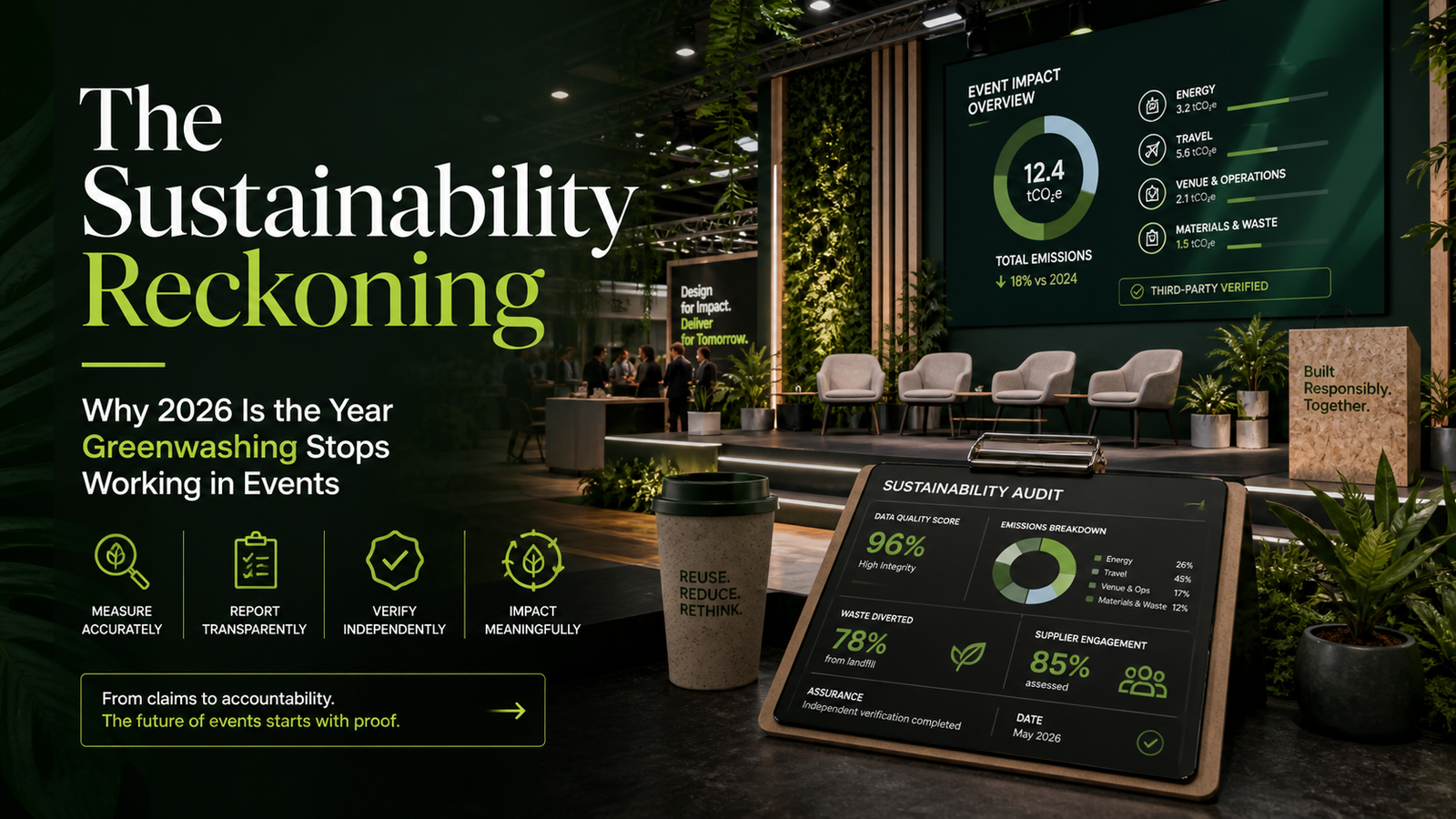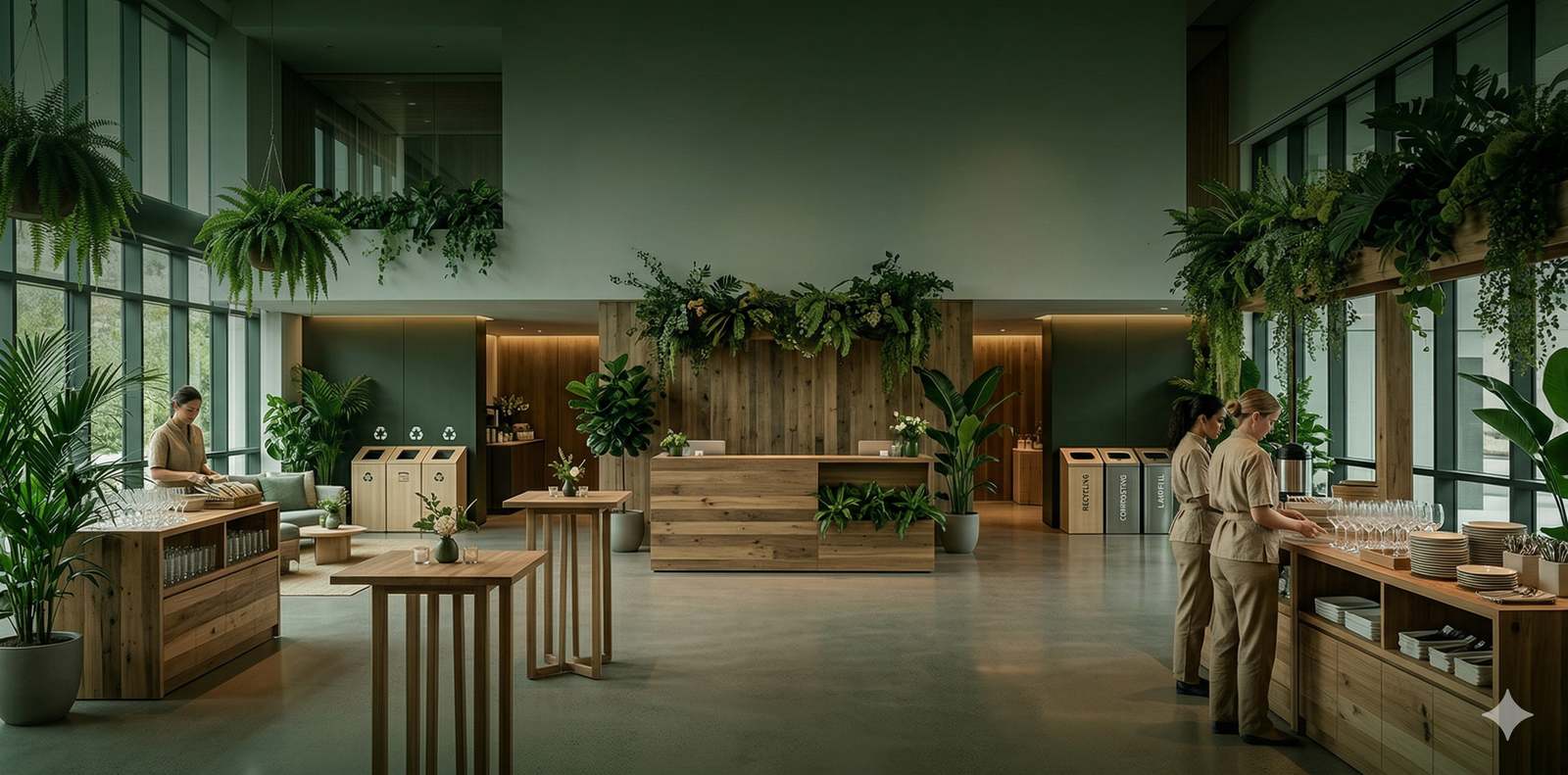
The average event generates 2.5 kg of waste per attendee per day. A 1,000-person, two-day conference produces roughly 5 tonnes of waste - most of it ending up in landfill. Zero-waste event planning is the systematic effort to divert 90% or more of that waste from landfill through reduction, reuse, recycling, and composting.
This is not about greenwashing or swapping plastic cups for paper ones. It is about fundamentally redesigning how events source materials, feed people, build structures, and handle what is left behind. Done right, many zero-waste strategies actually save money. Done wrong, they become expensive PR exercises that fool nobody.
This playbook covers every waste category at events with actionable strategies, real cost comparisons, and measurable benchmarks.
What Zero-Waste Actually Means
The Zero Waste International Alliance defines zero waste as diverting 90% or more of materials from landfill and incineration. For events, this means:
- 90%+ diversion rate from landfill (measured by weight)
- Waste hierarchy applied: refuse first, then reduce, reuse, recycle, compost - landfill is the last resort
- Full lifecycle thinking: sustainability starts at procurement, not at the bin station
No event achieves literally zero waste. The goal is to get as close to 90% diversion as possible while being honest about what you cannot yet eliminate.
The Event Waste Problem in Numbers
| Metric | Industry Average | Zero-Waste Target |
|---|---|---|
| Waste per attendee per day | 2.5 kg | Under 0.5 kg |
| Food waste percentage | 30-40% of catered food | Under 10% |
| Landfill diversion rate | 15-25% | 90%+ |
| Single-use plastic items | 3-5 per attendee per day | Zero |
| Printed materials per attendee | 0.8 kg | Under 0.1 kg |
| Carbon footprint per attendee (1-day event) | 50-100 kg CO2e | Under 20 kg CO2e |
Step 1: The Event Waste Audit Framework
You cannot manage what you do not measure. Before implementing any sustainability strategy, establish your waste baseline.
Pre-Event Waste Audit
Map every material that will enter your event and plan its exit route before it arrives:
- List every input material - printed badges, banners, food packaging, exhibition materials, swag bags, lanyards, stage set materials
- Classify by waste stream - recyclable, compostable, reusable, or landfill
- Identify the top 5 waste generators - these typically account for 80% of event waste
- Set diversion targets for each category
- Assign responsibility for each waste stream to a specific team member or vendor
Post-Event Waste Measurement
Weigh and document every waste stream after the event:
- Total waste generated (kg)
- Waste diverted to recycling (kg)
- Waste diverted to composting (kg)
- Waste reused or donated (kg)
- Waste sent to landfill (kg)
- Calculate diversion rate: (Total - Landfill) / Total x 100
Use the EventSphereX Budget Calculator to model the cost impact of sustainable alternatives against your traditional event budget.
Step 2: Category-by-Category Sustainability Playbook
Catering: The Biggest Impact Area
Food and beverage waste is the single largest waste category at most events, representing 40-60% of total waste by weight. It is also the area where sustainable choices can save the most money.
Plant-Forward Menus
Shifting toward plant-based menus reduces both food waste and carbon footprint:
- Carbon impact: A plant-based meal produces 2.5 kg CO2e compared to 6.5 kg CO2e for a meat-based meal
- Cost impact: Plant-forward menus are typically 15-25% less expensive than meat-heavy menus
- Waste reduction: Vegetable-based dishes have longer hold times and lower spoilage rates than meat dishes
This does not mean forcing everyone to eat vegan. It means making plant-based options the default and meat the opt-in choice. A menu split of 60% plant-based, 30% poultry/fish, and 10% red meat is a practical starting point.
Portion Planning
The number one cause of food waste at events is over-ordering. Use these benchmarks:
| Meal Type | Portion per Person | Buffer |
|---|---|---|
| Sit-down lunch | 400-500g total | 5-8% |
| Buffet lunch | 500-600g total | 10-12% |
| Cocktail reception (2 hours) | 6-8 pieces + 2 drinks | 8-10% |
| Conference tea break | 150-200g | 5% |
| Gala dinner | 500-650g total | 5-8% |
Key rule: Order for 95% of confirmed attendees for sit-down meals and 90% for buffets (accounting for no-shows). This single adjustment typically reduces food waste by 15-20%.
Compostable vs Reusable Serviceware
| Option | Cost per Unit | Environmental Impact | Practical Considerations |
|---|---|---|---|
| Single-use plastic | $0.05-0.15 | High - 500+ years to decompose | Cheap but unsustainable |
| Compostable (PLA/bagasse) | $0.15-0.40 | Medium - requires industrial composting | Needs composting facility access |
| Reusable (washed on-site) | $0.50-1.50 per use | Low - if washed efficiently | Needs dishwashing setup, staff |
| Reusable (rental service) | $0.80-2.00 per use | Low | Best for 500+ person events |
Recommendation: For events under 300 people, reusable serviceware with on-site washing is most cost-effective over 3+ events. For larger events, compostable serviceware is practical if you have confirmed access to an industrial composting facility.
Food Donation Partnerships
Surplus food can be donated rather than wasted. In many countries, Good Samaritan laws protect food donors from liability.
- India: The Food Safety and Standards (Recovery and Distribution of Surplus Food) Regulations 2019 mandate that food businesses with surplus should donate to food banks or NGOs. Partner with organisations like Feeding India (Zomato), Robin Hood Army, or No Food Waste.
- US/UK/EU: Partner with organisations like City Harvest, FareShare, or the Global FoodBanking Network.
- Logistics: Arrange pickup within 2 hours of event close. Pre-register with the donation partner and coordinate packaging requirements.
Materials and Print: The Digital-First Approach
Printed materials are the second largest waste generator at events. The shift to digital is not just sustainable - it is cheaper and more effective.
What to Eliminate
| Traditional Item | Digital Alternative | Waste Reduction | Cost Saving |
|---|---|---|---|
| Printed programmes | Event app / QR code to PDF | 0.3-0.5 kg per attendee | 60-80% |
| Paper name badges | Digital badges on phone / reusable badge with paper insert | 0.02 kg per badge | 30-50% |
| Brochures and handouts | Post-event email with links | 0.5-1.0 kg per attendee | 90%+ |
| Printed signage | LED/digital signage | Varies | Higher upfront, lower lifecycle |
| Physical feedback forms | QR code to online survey | 0.01 kg per form | 95% |
When Print is Still Necessary
Some printed materials remain essential for accessibility and wayfinding:
- Emergency exit signage (regulatory requirement)
- Large wayfinding signs (digital screens are not always visible in bright venues)
- Accessibility materials (braille, large print for visually impaired attendees)
For necessary print, use:
- FSC-certified paper
- Vegetable-based or soy-based inks
- Print on both sides
- Design for reuse (no event-specific dates on permanent signage)
Exhibition Builds: Modular and Reusable Systems
Exhibition booth construction is one of the most wasteful aspects of the events industry. A typical custom-built 36 sqm booth generates 500-800 kg of waste after a single show.
The Shift to Modular
Modular booth systems like Octanorm, Aluvision, and BeMatrix use aluminium frames with swappable graphic panels. The structure is reused across 20-50+ events; only the graphics change.
Cost comparison over 3 events:
| Approach | Event 1 | Event 2 | Event 3 | Total | Waste (3 events) |
|---|---|---|---|---|---|
| Custom build each time | $25,000 | $25,000 | $25,000 | $75,000 | 1,500-2,400 kg |
| Modular system | $35,000 | $8,000 | $8,000 | $51,000 | 100-200 kg |
| Savings with modular | - | - | - | $24,000 (32%) | 85-92% less waste |
For detailed exhibition booth cost analysis, see our guide on Exhibition Stall Construction Costs in India.
Sustainable Flooring
Traditional exhibition carpet is one of the most wasted materials in the industry - used once and landfilled. Sustainable alternatives include:
- Reusable interlocking tiles (like Retile Floor systems) - made from recycled materials, reusable 50+ times
- Reclaimed wood planking - rented and returned after the event
- Natural fibre carpets - jute or sisal that can be composted after use
Read our in-depth analysis of Sustainable Exhibition Flooring with Retile Floor for cost comparisons and installation guides.
Energy: Renewable Power and Efficiency
Events consume significant energy, primarily through lighting, AV equipment, HVAC, and catering infrastructure.
Energy Reduction Strategies
| Strategy | Impact | Implementation Cost |
|---|---|---|
| LED-only lighting | 60-75% energy reduction vs halogen | Minimal (LED is now standard) |
| Smart HVAC scheduling | 15-25% energy reduction | Low (programming existing systems) |
| Motion-sensor lighting in low-traffic areas | 10-15% energy reduction | $500-2,000 for sensor installation |
| Efficient AV equipment | 20-30% energy reduction | Specify in AV tender requirements |
| Solar-powered temporary structures | 40-60% grid energy offset | $5,000-15,000 for temporary solar |
Carbon Offsets
When you cannot eliminate emissions, offset them. But do it credibly:
- Calculate first. Use the GHG Protocol or ISO 14064 methodology to measure your event's carbon footprint
- Reduce first, offset second. Offsets should cover residual emissions after reduction efforts, not replace them
- Buy verified offsets. Gold Standard or Verified Carbon Standard (VCS) certified projects only
- Cost: $10-25 USD per tonne of CO2e for verified offsets. A 1,000-person conference typically generates 50-150 tonnes CO2e, making the offset cost $500-3,750
Transport: The Largest Carbon Contributor
Attendee and speaker travel typically accounts for 70-85% of an event's total carbon footprint. This is the hardest category to control but the most impactful to address.
Venue Selection for Reduced Travel
- Choose venues accessible by public transport (within 500m of metro/rail station)
- Select venues close to airports for events with significant air travel
- Consider regional rotation for annual conferences (reducing average travel distance)
- Evaluate hybrid options to reduce the number of attendees who need to travel
Event-Day Transport
- Shuttle services from major transit hubs to venue (reduces individual car trips by 40-60%)
- Electric vehicle shuttles where available (now standard in Dubai, Singapore, and parts of Europe)
- Bicycle parking and cycle-share partnerships for urban venue events
- Carpooling coordination through event app or WhatsApp groups
Carbon Offset Programs for Attendees
Offer voluntary carbon offsetting at registration:
- Calculate estimated travel emissions based on attendee origin city
- Add an opt-in offset fee (typically $5-25 per attendee)
- Partner with a verified offset provider
- Report total offsets purchased post-event
Merchandise and Swag: The Sustainability Paradox
Event swag is one of the most wasteful categories in the industry. Studies show that 60% of promotional products are discarded within 6 months.
The Best Swag Is No Swag
Seriously. Before creating any event merchandise, ask: "Will attendees use this for more than 6 months?" If the answer is no, do not make it.
If You Must Have Swag
| Sustainable Option | Approximate Cost | Lifespan | Carbon Impact |
|---|---|---|---|
| Seed paper business cards | $0.50-1.00 each | Grows into plants | Negative (carbon capture) |
| Reusable water bottle (quality) | $8-15 each | 3-5 years | Low if used regularly |
| Digital gift card / donation in attendee's name | $5-50 each | N/A | Near zero |
| Locally sourced food hamper | $10-25 each | Consumed (zero waste) | Low |
| Experience voucher (class, workshop) | $15-50 each | N/A | Near zero |
What to avoid: Cheap tote bags (every attendee already has 50), branded pens, USB drives (obsolete), plastic keychains, and anything made specifically for the event that has no use outside it.
Cost Comparison: Sustainable vs Traditional Events
The most common objection to sustainable events is cost. The reality is more nuanced than "green costs more."
Where Sustainability Saves Money
| Category | Traditional Cost | Sustainable Cost | Saving |
|---|---|---|---|
| Printed materials | $5,000 | $1,200 (digital-first) | 76% |
| Catering (portion-optimised) | $50,000 | $42,000 | 16% |
| Exhibition flooring (3 events) | $9,000 | $5,500 (reusable tiles) | 39% |
| Swag bags | $8,000 | $3,000 (curated/digital) | 63% |
| Waste disposal (reduced volume) | $3,500 | $2,000 | 43% |
Where Sustainability Costs More
| Category | Traditional Cost | Sustainable Cost | Premium |
|---|---|---|---|
| Compostable serviceware | $2,000 | $3,200 | 60% |
| Renewable energy sourcing | $0 (grid default) | $2,000-5,000 | New cost |
| Carbon offset purchase | $0 | $1,000-3,750 | New cost |
| Reusable signage system (Year 1) | $4,000 | $7,000 | 75% |
| Sustainability certification audit | $0 | $3,000-8,000 | New cost |
Net Impact
For a typical 500-person, 2-day conference, switching to a comprehensive sustainability approach results in:
- Year 1: 5-15% higher total cost (investment in reusable systems)
- Year 2: Break-even to 5% savings (reusable systems pay for themselves)
- Year 3+: 10-20% net savings (compounding returns from reusable materials, reduced waste disposal, and optimised catering)
Sustainability Certification Programs
Certification provides credibility and framework. Without it, sustainability claims are just marketing.
ISO 20121: Event Sustainability Management
The international standard for sustainable event management. Key features:
- Scope: Covers the entire event management system, not just individual events
- Requirements: Policy commitment, stakeholder engagement, supply chain management, performance measurement
- Certification cost: $5,000-15,000 for initial audit, $2,000-5,000 for annual surveillance
- Notable adopters: London 2012 Olympics, UEFA Euro, Formula E, Glastonbury Festival
- Best for: Large-scale event organisers, venues, and production companies
Other Certification Programs
| Certification | Region | Focus | Cost |
|---|---|---|---|
| Green Events Certification (A Greener Festival) | Global | Music and cultural events | $500-2,500 |
| APEX/ASTM Environmentally Sustainable Standards | North America | Conventions and exhibitions | Varies by venue |
| Green Globe | Global | Venues and destinations | $2,500-5,000/year |
| Indian Green Building Council (IGBC) Green Events | India | Events in IGBC-certified venues | Part of venue certification |
| BS 8901 (precursor to ISO 20121) | UK | Event sustainability | Legacy - migrate to ISO 20121 |
Measuring and Reporting Event Carbon Footprint
What to Measure
The GHG Protocol divides emissions into three scopes:
- Scope 1: Direct emissions from event-owned sources (generators, company vehicles)
- Scope 2: Indirect emissions from purchased energy (venue electricity, HVAC)
- Scope 3: All other indirect emissions (attendee travel, supply chain, waste disposal, catering)
For events, Scope 3 typically represents 85-95% of total emissions. You cannot claim carbon neutrality while ignoring Scope 3.
Carbon Footprint Estimation Formula
A simplified estimation for events:
| Source | Calculation | Typical Range |
|---|---|---|
| Air travel | Number of flights x average distance x 0.255 kg CO2e/km | 30-100 kg per attendee |
| Ground transport | Number of car-km x 0.21 kg CO2e/km | 5-20 kg per attendee |
| Venue energy | kWh consumed x grid emission factor | 3-10 kg per attendee |
| Catering | Meals served x meal emission factor (5-10 kg CO2e/meal) | 5-20 kg per attendee |
| Accommodation | Room-nights x 20-30 kg CO2e/night | 20-60 kg per attendee |
| Materials and waste | Estimated weight x disposal emission factors | 2-5 kg per attendee |
Reporting
Publish a post-event sustainability report that includes:
- Total waste generated and diversion rate
- Carbon footprint by scope and source
- Comparison to previous year (if applicable)
- Specific reduction initiatives and their measured impact
- Targets for the next event
- Honest disclosure of areas where you fell short
Greenwashing Pitfalls to Avoid
Greenwashing destroys trust faster than genuine sustainability builds it. Avoid these common traps:
- "Eco-friendly" without data. If you cannot quantify the environmental benefit, do not claim it.
- Offsetting without reducing. Buying carbon credits while making no effort to reduce emissions is greenwashing.
- Biodegradable claims without composting access. Biodegradable cups in a landfill decompose just as slowly as plastic - they need industrial composting.
- One green initiative, everything else unchanged. Banning plastic straws while serving 2,000 single-use plastic water bottles is performative.
- Green sponsor logos without vetting. If your "sustainability partner" is a fossil fuel company, your audience will notice.
- Ignoring Scope 3 emissions. Claiming "carbon neutral event" based only on venue energy while 800 attendees flew in is dishonest.
- Reusable items that nobody reuses. A "reusable" tote bag that goes in the bin after one use has a higher carbon footprint than the plastic bag it replaced.
India-Specific Sustainability Challenges and Solutions
Waste Segregation Infrastructure
India's waste management infrastructure varies dramatically between cities. Key challenges:
- Limited industrial composting facilities outside Tier 1 cities
- Informal waste sector handles 15-20% of urban waste - partner with registered waste picker cooperatives rather than bypassing them
- Mixed waste collection in most municipalities makes on-site segregation essential
Solutions:
- Contract a private waste management company (Saahas, Nepra, or Hasiru Dala) for on-site segregation and certified disposal
- Set up clearly labelled 4-bin stations: dry recyclable, wet/compostable, sanitary/medical, and reject/landfill
- Hire waste management marshals (1 per 200 attendees) to guide correct disposal
CPCB and State Pollution Control Board Guidelines
The Central Pollution Control Board (CPCB) Plastic Waste Management Rules 2024 ban single-use plastics below 120 microns. For events, this means:
- No plastic cutlery, plates, cups, straws, or stirrers
- No plastic banners below 120 microns (use cloth or recycled PET)
- E-waste from event technology must be disposed through authorised e-waste recyclers
- Noise pollution norms apply (75 dB daytime, 70 dB nighttime in commercial zones)
NGO Partnerships for Food Donation
Indian food donation ecosystem:
| Organisation | Coverage | Minimum Quantity | Lead Time |
|---|---|---|---|
| Feeding India (Zomato) | 200+ cities | 25 meals | 2-4 hours |
| Robin Hood Army | 200+ cities | 50 meals | 4-6 hours |
| No Food Waste | Tamil Nadu, Karnataka | 20 meals | 2-3 hours |
| Roti Bank (Akshaya Patra) | Mumbai, Delhi, Bangalore | 100 meals | 4-6 hours |
| Annakshetra | Delhi NCR | 30 meals | 3-4 hours |
Register with at least two food donation partners before your event and confirm pickup logistics in advance.
Case Studies: Zero-Waste Events That Worked
Salesforce Dreamforce (San Francisco)
- Scale: 45,000+ attendees
- Achievement: 80% waste diversion rate in 2024, up from 65% in 2022
- Key strategies: All compostable serviceware, on-site composting stations, digital-only badges and programmes, reusable water bottle stations every 50 metres
- Cost impact: 12% reduction in waste disposal costs year-over-year
Greenbuild International Conference (US)
- Scale: 20,000+ attendees
- Achievement: 93% waste diversion rate - one of the highest for a conference of this size
- Key strategies: Zero single-use plastics, mandatory sustainability reporting from all exhibitors, food donation partnership with local food banks, carbon-neutral transport shuttles
- Cost impact: Sustainability premium of 8% in Year 1, net positive by Year 3
India: CII Green Building Congress (Various Cities)
- Scale: 3,000-5,000 attendees
- Achievement: 85% waste diversion, zero single-use plastic since 2022
- Key strategies: Digital-first communications, locally sourced vegetarian catering, modular exhibition systems, partnership with Saahas for waste management
- Cost impact: 10% lower F&B costs from portion optimisation, marginal increase in waste management costs offset by print savings
Glastonbury Festival (UK)
- Scale: 200,000+ attendees
- Achievement: Banned single-use plastic bottles in 2019, 60%+ waste diversion (exceptional for an outdoor festival)
- Key strategies: Reusable cup deposit system, on-site recycling sorting facility (employs 1,500 volunteers post-event), composting toilets, solar and wind-powered stages
- Lesson: Even the most challenging event formats can make dramatic sustainability improvements
Building Your Zero-Waste Event Timeline
6 Months Before
- Conduct baseline waste audit from previous event data
- Set diversion rate target (realistic: 70% for first attempt, 85%+ for experienced teams)
- Select waste management partner
- Include sustainability requirements in all vendor RFPs
- Begin sustainability certification process if pursuing ISO 20121
3 Months Before
- Finalise catering with portion planning and plant-forward menu
- Confirm compostable/reusable serviceware plan
- Design digital-first communications (eliminate print wherever possible)
- Plan waste station layout (1 station per 100 attendees)
- Register with food donation partners
1 Month Before
- Brief all vendors on waste segregation requirements
- Order bin station supplies and signage
- Train waste management marshals
- Confirm carbon offset purchase for estimated emissions
- Prepare sustainability report template
Event Day
- Deploy waste stations before attendees arrive
- Station waste marshals at every food service area
- Monitor waste streams in real-time (adjust signage if contamination is high)
- Coordinate food surplus pickup with donation partners 1 hour before event close
- Begin post-event waste measurement immediately
1 Week After
- Complete waste measurement and calculate diversion rate
- Compile carbon footprint data
- Draft sustainability report
- Debrief with waste management partner
- Document lessons learned for next event
Need help planning the full event? Check our Event Planning Checklist and the EventSphereX Event Checklist Generator for a customisable planning timeline.
Frequently Asked Questions
1. What does "zero-waste event" actually mean?
A zero-waste event diverts 90% or more of its waste from landfill and incineration, as defined by the Zero Waste International Alliance. It does not mean literally producing zero waste - that is practically impossible. The focus is on designing out waste through the hierarchy of refuse, reduce, reuse, recycle, and compost, with landfill as the absolute last resort.
2. How much does a zero-waste event cost compared to a traditional event?
In Year 1, expect a 5-15% cost premium due to investments in reusable systems, waste management infrastructure, and potentially higher-cost compostable materials. However, savings on print, optimised catering portions, and reduced waste disposal fees offset much of this. By Year 2-3, most organisers report net savings of 10-20% from cumulative efficiencies.
3. How do I measure my event's waste diversion rate?
Weigh all waste by category after the event: recyclables, compostables, donations, reusables, and landfill. The diversion rate formula is: (Total waste - Landfill waste) / Total waste x 100. For accurate measurement, contract a waste management company that provides weigh-in data by stream, or rent portable scales for on-site measurement.
4. Can I claim "carbon neutral" for my event?
You can if you measure your full carbon footprint (including Scope 3 - attendee travel, supply chain) and purchase verified carbon offsets for 100% of emissions. However, best practice is to reduce emissions first and offset only the residual. Always use verified offset programmes (Gold Standard or Verified Carbon Standard) and disclose your methodology transparently.
5. What are the best alternatives to single-use plastic at events?
For serviceware: reusable plates and cutlery with on-site washing for events under 500 people, or certified compostable items (PLA, bagasse) for larger events - but only if you have access to industrial composting. For water: refill stations with reusable bottles. For packaging: bulk dispensers instead of individual packets.
6. How do I handle food waste at large events?
Three strategies in priority order. First, reduce: portion-plan using per-person benchmarks and order for 90-95% of confirmed attendees. Second, donate: partner with food rescue organisations for surplus. Third, compost: ensure all food waste goes to composting, not landfill. Register with food donation partners before the event and confirm pickup logistics in advance.
7. Is ISO 20121 certification worth it?
For large-scale event organisers, venues, and production companies - yes. It provides a structured management system, improves vendor accountability, and is increasingly requested in government and corporate tenders. For small or occasional event organisers, the certification cost ($5,000-15,000) may be disproportionate. Instead, adopt the ISO 20121 framework informally without pursuing formal certification.
8. How do I prevent greenwashing at my event?
Three rules. First, quantify everything - if you cannot measure the environmental benefit, do not claim it. Second, be honest about what you have not solved (attendee air travel is always the elephant in the room). Third, publish a post-event sustainability report with actual data, including where you fell short of targets. Transparency is the antidote to greenwashing.
9. What are the biggest waste reduction wins for a first-time sustainable event?
Start with the top three high-impact, low-cost changes. First, go digital-first on all print materials (saves 60-80% of print costs and waste). Second, optimise catering portions and set up food donation (saves 15-20% on F&B and diverts the single largest waste stream). Third, eliminate single-use plastic water bottles with refill stations (visible sustainability signal and cost-saving).
10. How do I get buy-in from stakeholders and sponsors for sustainable events?
Lead with the business case. Show the cost savings data from catering optimisation, print elimination, and multi-year reusable material savings. For sponsors, highlight that 73% of consumers prefer brands associated with sustainability (Nielsen Global Sustainability Report). For corporate clients, note that sustainability reporting requirements (BRSR in India, CSRD in the EU) increasingly require supply chain sustainability data - including events.
Conclusion
Zero-waste events are not a trend or a niche practice - they are becoming an operational standard. Regulatory pressure (CPCB plastic bans in India, EU Single-Use Plastics Directive), corporate sustainability mandates (ESG reporting), and attendee expectations are all converging on the same outcome: events that waste less, measure more, and take accountability for their environmental impact.
Start with the high-impact, low-cost strategies - digital-first communications, portion-optimised catering, and single-use plastic elimination. Build toward modular exhibition systems, comprehensive waste measurement, and eventually ISO 20121 certification. The economics work in your favour: most sustainable strategies either save money immediately or pay for themselves within 2-3 events.
The question is no longer whether to plan sustainable events. It is how fast you can get there.
Ready to plan your sustainable event budget? Use the EventSphereX Budget Calculator to model costs across every category, from catering to waste management.