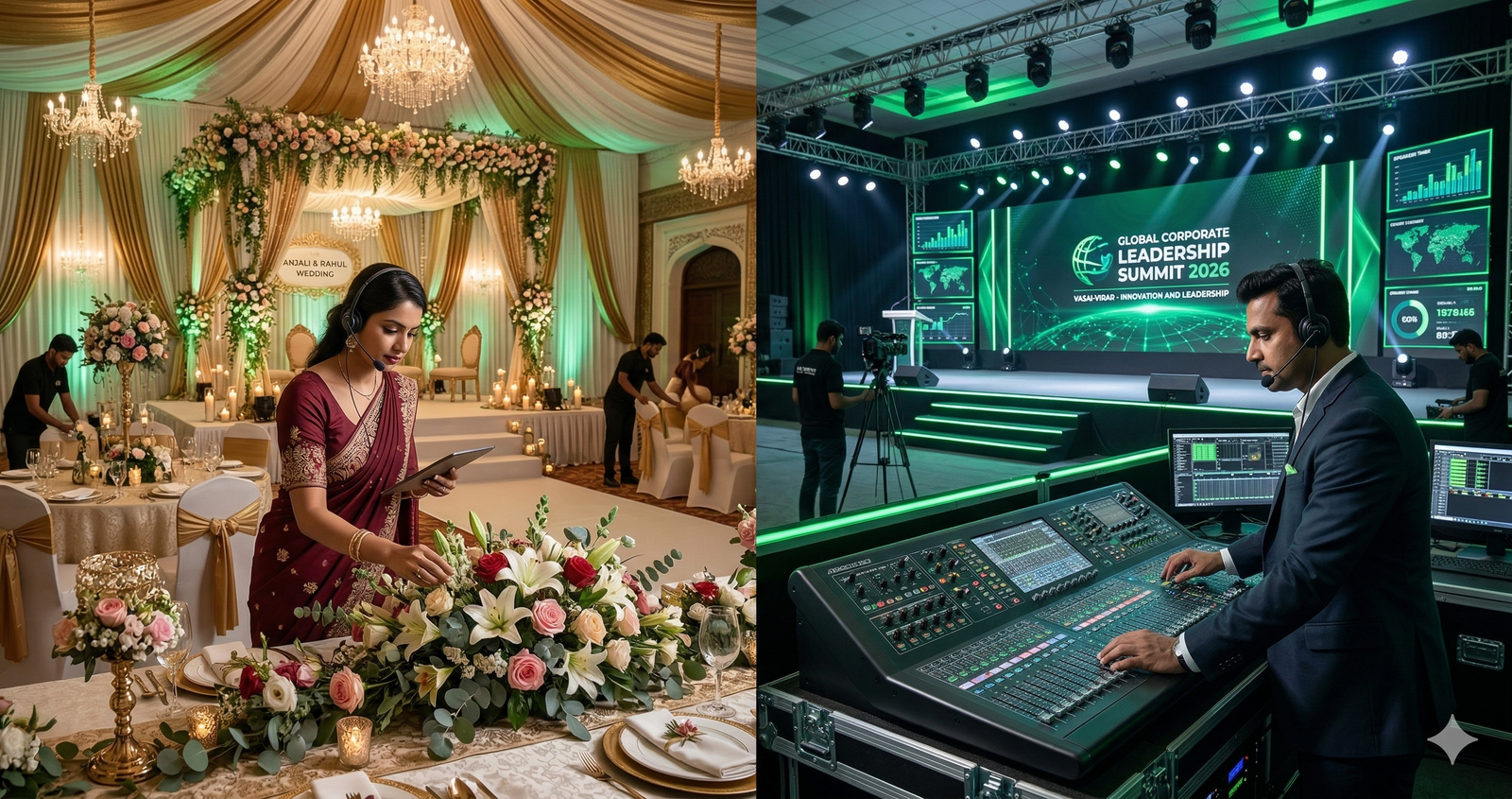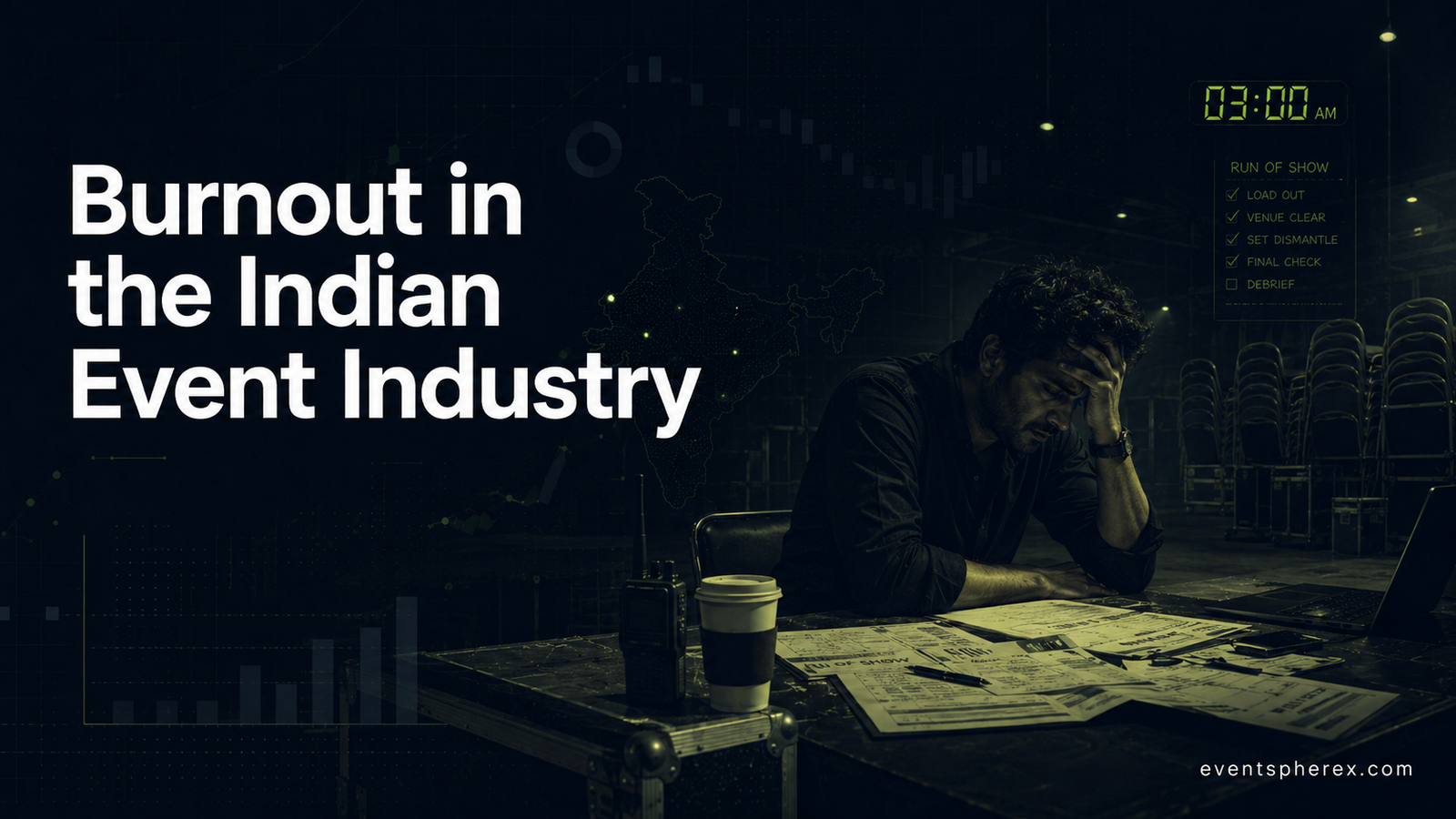
Why the Indian Event Industry Burns People Out Faster Than Most
Three industry-specific factors stack up:
- Sprint-based work cycles. A 12-week event cycle ends with 72 hours of zero sleep, a load-out at 4 AM, and the next event briefing at 11 AM the same day.
- Always-on client expectations. WhatsApp made event ops a 24/7 job. There is no "out of office" between a sponsor and a delivery team.
- Compressed peak seasons. Wedding season (Oct-Feb), MICE season (Sep-Mar) and exhibition season (Jan-Mar) overlap. The same humans handle all three.
Layer on Indian-specific patterns: late client payments, joint-family obligations, rising metro costs, and a cultural taboo around saying "I'm not okay," and you get an industry where exhaustion is treated as a credential.
It is not a credential. It is a slow disability.
The Early Warning Signs Most People Miss
Burnout rarely arrives as a dramatic breakdown. It arrives as small shifts that get normalised:
- Sleep collapse. You stop sleeping more than 4-5 hours even when you have time.
- The Sunday dread. Not just before a hard week - before every week.
- Decision paralysis. You can run a 5,000-pax show but can't decide what to eat for dinner.
- Cynicism creep. "Clients are all idiots." "Vendors are all crooks." Things you didn't say two years ago.
- Loss of pride in the work. You stop watching the AV check, stop noticing decor, stop caring whether the AV vendor reused yesterday's gels.
- Physical signs. Recurrent throat infections, gut issues, weight gain or loss without trying, persistent shoulder/lower-back pain.
If you have three or more of these for more than four weeks, you are not "just tired." You are running a deficit. The industry will not pay it back. You have to.
What Actually Works (and What Doesn't)
What Doesn't Work
- "Just take a holiday." A weekend in Goa does not reverse 14 weeks of cumulative sleep debt.
- Generic productivity hacks. Pomodoro doesn't help when your day is structured around external client emergencies.
- "Work harder, deliver bigger, money will fix it." Burnout makes income worse, not better, because performance degrades.
What Does Work
1. Sleep protection. Non-negotiable.
- 7+ hours per night for at least 5 nights a week between events.
- The 48 hours after load-out are sleep time, not catch-up email time.
- One full day per week with no work calls. (Not a half-day. A full day.)
2. Post-event recovery protocol. After every major event, force-protect 2-4 days of light schedule. No new pitches, no client meetings except essential. Use it for invoicing, debrief, body recovery. Treat it like a contractual deliverable to yourself.
3. Selective project intake. The events that destroy you are the ones with: unclear scope, reactive clients, payment terms longer than 60 days, and chronic last-minute changes. Saying no to one of these per quarter buys back hundreds of hours.
4. Financial buffer. A cash buffer of 2-3 months of personal expenses changes the maths of every "I have to take this terrible client" decision. This is the single highest-leverage intervention. Until you have it, you cannot say no - and not being able to say no is what burns people out.
5. Peer community. Not LinkedIn cheerleading. Real, small WhatsApp/Signal groups of 5-10 event peers who can vent, swap rate cards, and warn each other about toxic clients. The isolation of producer-life is half the problem.
6. Therapy / counselling. Still treated as exotic in Indian events; it shouldn't be. A good therapist costs Rs 2,000-4,000 a session and can prevent Rs 5L of lost income from a 6-month motivation collapse.
What Agency Owners and Producers Should Do Differently
If you run an agency, you have leverage that individuals don't. Use it.
- Build a recovery clause into project planning. After every event >Rs 50L size, the team gets 3 working days of low-load schedule. No exceptions.
- Cap consecutive event weekends. Three in a row is the real ceiling for any human. Four is when quality degrades and people start leaving.
- Pay on time. This is a mental-health policy, not just an HR policy. Late freelancer and crew payments are the most common source of resentment burnout.
- Make it safe to say no. A team member who declines a project because they are exhausted should not be punished. They should be respected. The cost of replacing burned-out talent is far higher.
- Insurance and health benefits. Even a basic group health plan plus mental-health coverage is a recruiting differentiator in 2026.
A Reality Check on the "Glamour" Narrative
Indian event-industry social media celebrates the long nights, the heroic load-outs, the all-hands sprints. Some of that is real. Some of it is harm dressed up as identity.
The producers and agency owners with 20+ year careers in this industry - the ones still creatively fresh - are not the ones who stayed up the most nights. They are the ones who learned, somewhere around year 5 or 7, to draw a line. They have a life. They have hobbies that have nothing to do with events. They go home before midnight when they can. They have built businesses that don't require them to suffer to function.
That is the model. Not the burnout-as-badge model.
When to Take a Real Break (Not Just a Holiday)
Sometimes a recovery week isn't enough. The signs you need a longer reset - 4 to 12 weeks - are:
- You have lost the ability to feel proud of any delivered event in the last 12 months.
- You are using alcohol, sleep medication, or stimulants in a pattern that has escalated.
- Personal relationships are visibly cracking - partner, parents, close friends.
- Health markers (BP, sugar, cardiac) have started to flag.
If two or more of these are true, plan a real break. Hand off projects. Take leave. The industry will still be here when you come back. Your body and brain might not.
Building a Career That Lasts
A 30-year career in Indian events looks like:
- Years 0-3: build skills across formats. Yes, work hard. But pace it.
- Years 3-7: pick your category (corporate, weddings, MICE, festivals, brand). Don't try to be everything.
- Years 7-12: build IP - a tool, a method, a vendor network, a niche reputation. Stop being an interchangeable producer.
- Years 12-20: lead. Build teams. Choose fewer, bigger projects.
- Years 20+: senior, advisory, or owner. The sprint stops; the value compounds.
Most people who burn out in years 3-7 did so because they tried to skip stages, take on too much, or didn't have the financial buffer to refuse the wrong project. Build the buffer. Take the time. The career adds up.
Closing Note
Burnout in Indian events is not a personal failing. It is what happens when a high-emotion, high-stakes industry meets cultural norms that don't permit people to rest. The fix is partly individual (sleep, money buffer, therapy, peer community) and partly structural (better agency practices, on-time payments, fewer event-back-to-back weeks).
If you are reading this exhausted, with a Sunday-night dread already building, the first thing to do is the smallest one. Sleep tonight. Plan one full day off this week. Say no to one project this month. Build from there.
The industry will run without you for a week. It will not run as well without you for a decade.
Thinking about your next career move in Indian events? Browse open roles on the EventSphereX Job Board - or list yourself in the Industry Directory if you're going freelance.