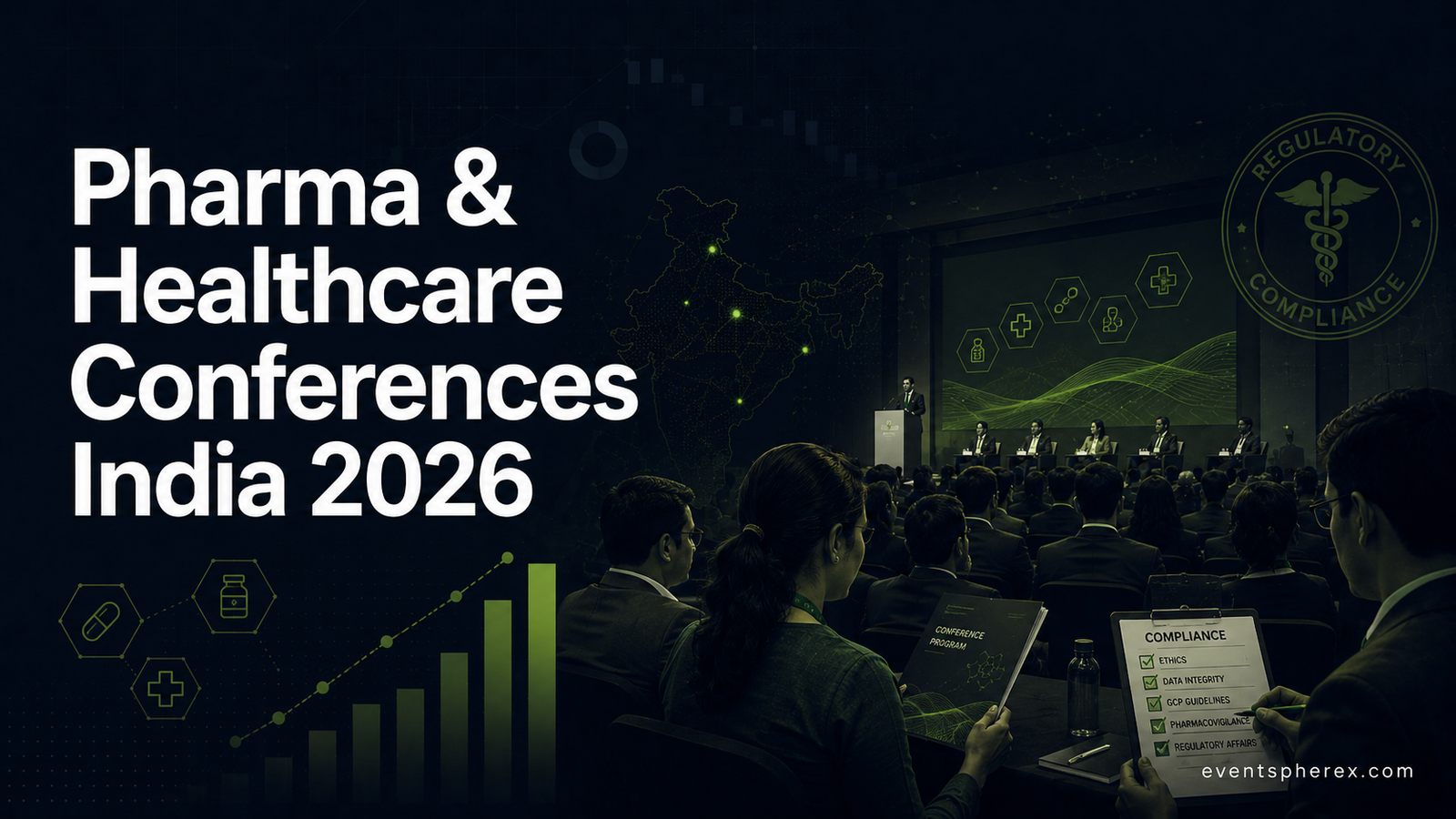
Why Pharma Is the Most Underrated MICE Segment
Most Indian event coverage skips pharma, because it doesn't have the visual drama of a wedding or a tech keynote. That is the entire reason it is underrated.
Pharma conferences are:
- Recurring - annual society meetings (cardiology, oncology, gastroenterology, endocrinology, gynaecology, pediatrics, surgery, etc.) run year after year, with multi-year planning cycles.
- Funded - pharma companies sponsor satellite symposia and CME tracks at scale, often committing Rs 50L-5Cr per major society conference.
- High-attendance - annual society conferences pull 2,000-10,000+ delegates. APICON (physicians), CSI (cardiology), AIOC (ophthalmology), and FOGSI (gynaecology) routinely cross 8,000-15,000 delegates.
- National + international - many Indian societies bring international faculty, multilingual interpretation, and live broadcast.
A serious Indian MICE agency should have at least one named team-line for healthcare. The work is steady; the margins are reasonable; and the relationships compound over decades.
The 2026 Major Conference Calendar (Indicative)
These are the conferences Indian healthcare event agencies plan around. Exact 2026 dates vary - confirm with the organising society for your year:
- APICON - Annual conference of the Association of Physicians of India
- CSI - Cardiological Society of India annual conference
- AIOC - All India Ophthalmological Conference
- FOGSI / AICOG - Federation of Obstetric and Gynaecological Societies of India annual congress
- IADVL CUTICON / DERMACON - Indian Association of Dermatologists, Venereologists & Leprologists
- IOACON - Indian Orthopaedic Association
- AOICON - Association of Otolaryngologists of India
- PEDICON - Indian Academy of Pediatrics
- ISACON - Indian Society of Anaesthesiologists
- NEUROCON - Neurological Society of India / Indian Academy of Neurology
- IGCON / ISGCON - gastroenterology
- EMCON - Emergency Medicine Association of India
- ICCON - Indian Cancer Congress
- DIABETES INDIA / RSSDI - Research Society for the Study of Diabetes
- NEFROCON / ISNCON - nephrology
Plus a long tail of state-chapter conferences, hospital-branded symposia, and pharma-led therapy-area summits.
How Pharma Conferences Are Actually Funded
A typical national society conference budget breaks down roughly like this:
| Funding Line | % of Budget | Notes |
|---|---|---|
| Pharma & device sponsorship (satellite symposia, exhibition booths, branding) | 55-75% | The dominant line |
| Delegate registration fees | 10-25% | Tiered (member, non-member, PG, international) |
| Government / state grant | 0-5% | Occasional, not reliable |
| Society reserves | 0-10% | Used for shortfall |
| Other (publication, app, masterclass fees) | 2-5% | Growing area |
The pharma sponsor portion is the swing variable. In 2026, sponsor budgets are tighter post-pandemic recalibration but still substantial - and increasingly tied to clean compliance.
The Compliance Stack You Cannot Ignore
This is the single most important section of this article. Indian pharma events operate under a stack of rules that have hardened materially in the last 3-4 years:
1. National Medical Commission (NMC) Regulations
NMC's Registered Medical Practitioner Regulations (and previous MCI Code of Ethics 2002) set what doctors can and cannot accept from pharma. Doctors cannot accept gifts, hospitality, travel facilities, or paid vacations from pharma companies. Even attending a conference with sponsored travel/hospitality has tight limits.
The takeaway for event agencies: anything you would call "delegate hospitality" - flights, hotels, dinners - needs to be cleared through the conference organising committee and the sponsor's compliance team, not just booked.
2. UCPMP (Uniform Code of Pharmaceuticals Marketing Practices)
The 2024 mandatory UCPMP - issued by the Department of Pharmaceuticals - specifies what pharma companies can do at conferences:
- No gifts, samples to non-prescribers, or personal benefits to doctors
- Limits on hospitality (only food and beverage incidental to the educational session)
- Strict rules on speaker honoraria (must be reasonable, documented, scientific in purpose)
- Strict rules on what counts as "promotional material" vs "scientific information"
If your event includes a satellite symposium, the symposium content has to fit UCPMP definitions of scientific exchange - not promotional pitches.
3. Pharma Company Internal Codes
In addition to NMC and UCPMP, every major pharma company has its own internal code (often stricter than the legal floor). Global pharma companies in India typically follow IFPMA / EFPIA / PhRMA equivalents. Indian pharma companies follow OPPI's code.
This means: when a pharma sponsor signs up for your symposium, you will receive a compliance briefing. Read it. Apply it. The single fastest way to get blacklisted from pharma conferences is to break a sponsor's internal code.
4. CME Accreditation
If the conference offers CME credit, it must be accredited by a state medical council. The CME format has specific rules:
- The educational content must be independently determined by the scientific committee
- Sponsor logos can appear on signage and badges, but not on scientific slides
- Speakers must declare conflicts of interest
- The accreditation body audits
Agencies servicing CME conferences need a producer who has done it before. There are no shortcuts.
What Pharma Sponsors Actually Want
In 2026, pharma sponsorship asks have evolved beyond a banner and a booth. Sponsors want:
- Branded satellite symposia (60-90 minutes, scientific content, high-quality faculty)
- Booth presence with scientific information panels (no promotional gimmicks)
- Branded delegate bag inserts (often the cleanest UCPMP-friendly visibility)
- Sponsored coffee zones / catering (hospitality incidental to the meeting)
- Faculty meet-and-greets within compliance constraints
- Digital extension - same content available on the conference app, with sponsor logos
- CRM / lead capture within consent and privacy law (DPDP Act compliance, growing area)
A sponsor who returns next year is one whose specific compliance constraints you respected this year. It compounds.
Faculty / KOL Management
Healthcare conferences rise or fall on faculty. The KOL (key opinion leader) management stack includes:
- Identifying the right speakers (often through the scientific committee, not the agency)
- Inviting them with formal letters from the society
- Negotiating honoraria within compliance rules (documented, reasonable, scientific purpose)
- Booking travel and accommodation within sponsor and society guidelines
- Coordinating their session times, AV needs, and any abstract submissions
- Handling international faculty visa, immigration, FRRO formalities where required
Agencies that have a working list of KOL administrative practices (declarations, travel forms, post-event reporting) are far easier to work with than ones that improvise this each time.
What an Event Agency Needs to Bring to Pharma Work
To credibly compete for pharma conference work, an agency needs:
- A compliance-aware producer who has read NMC, UCPMP, and at least one pharma company's internal code
- A delegate management system (registration, accommodation, abstract submissions, CME tracking) - either licensed or built
- A scientific committee liaison capability - agencies don't dictate content; they enable the committee
- A broadcast / AV vendor stack capable of running multi-track sessions, live streaming, and recording
- Clean documentation - PO trails, compliance declarations, faculty COIs, post-event reports
The agencies that win 5-year framework contracts with societies are not the ones with the flashiest creative. They are the ones who deliver predictably and audit cleanly.
Where the Growth Is in 2026-28
- Therapy-area-specific summits (rare diseases, oncology precision medicine, women's health) - pharma is funding deep-niche events at higher per-event budgets
- Hospital-branded CME - large private hospital chains (Apollo, Fortis, Manipal, Max, Medanta) running their own branded medical education series
- Hybrid / digital extensions - most major society conferences now run a digital track that doubles total reach
- State chapter conferences - Tier-2 city growth in conference hosting (Lucknow, Bhopal, Chandigarh, Kochi, Indore, Coimbatore)
- Dental and allied health - under-represented in event agency portfolios; underserved market
Closing Note
Pharma and healthcare conferences are India's most boring, most steady, most under-marketed event segment - which is exactly why they are one of the best segments for a serious agency to build into a pillar of the business. The work is real, the budgets are committed, and the relationships compound over decades. Bring compliance discipline. Hire a producer who has done CME before. Read every sponsor's code. Treat the scientific committee with respect. The work follows.
Looking to plan delegate registration, satellite symposia layouts, or exhibition booth placements for your next medical conference? Try our free Stage Layout Planner and Industry Directory.