India's event industry is no longer only a network of agencies, venues, artists and vendors producing experiences. It is becoming measurable economic infrastructure.
The clearest evidence comes from KPMG in India's August 2026 study, Socio-economic impact of the Indian events and experiences industry. Its findings connect organised events with hotels, aviation, transport, catering, technology, tourism, retail, media and employment.
What did KPMG find about India's event economy?
| Organised segment | KPMG estimate |
|---|---|
| MICE | ₹46,739 crore |
| Live events | ₹13,600 crore |
| Commercial sports | ₹18,864 crore |
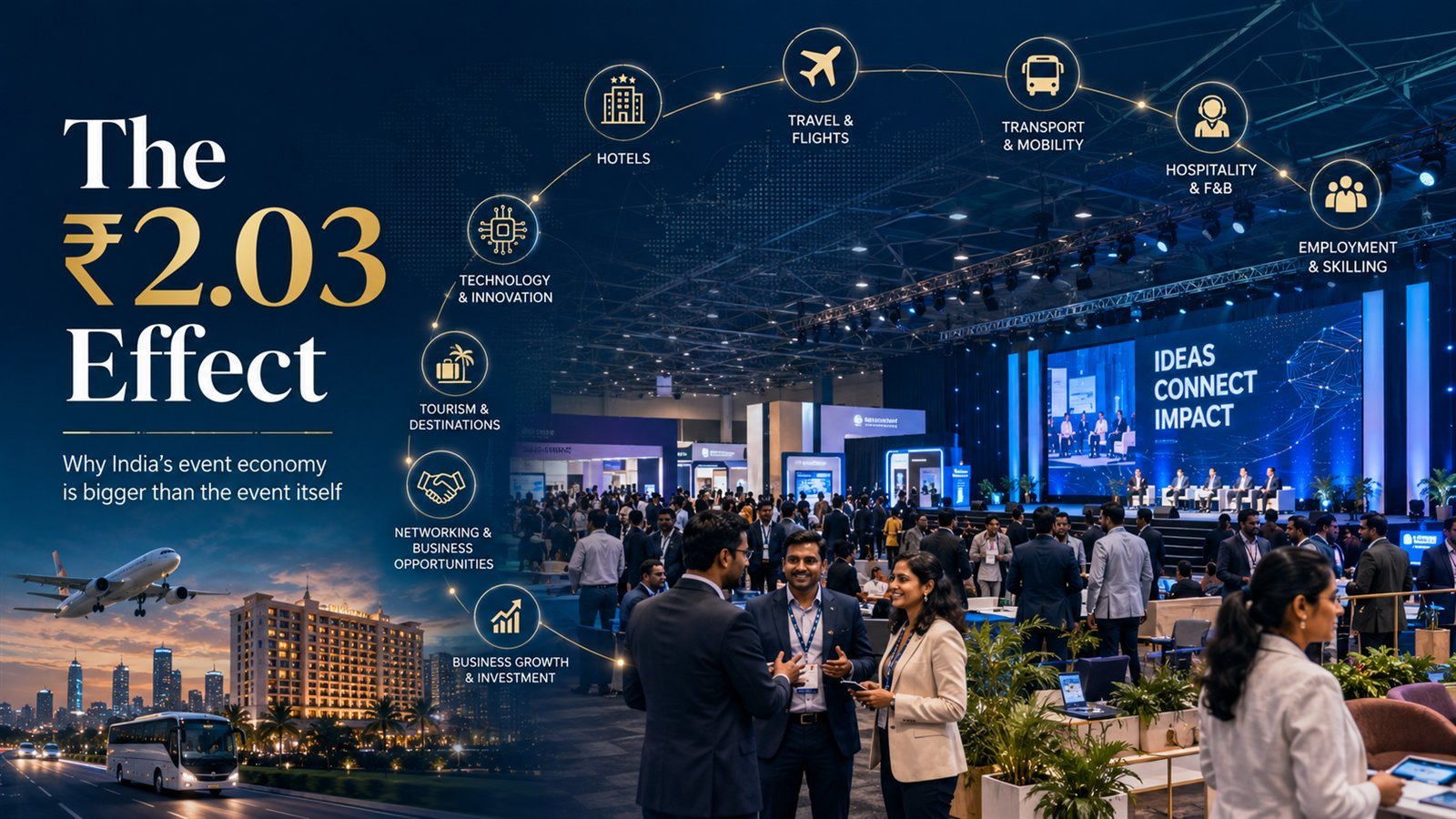
The study also associates every ₹1 of direct event-related expenditure with approximately ₹1.46 to ₹2.03 of total economic activity, depending on the category. MICE—meetings, incentives, conferences and exhibitions—recorded the highest multiplier at 2.03x.
That figure is an economic multiplier, not an organiser's return on investment. It captures how direct spending circulates through suppliers, workers and adjacent sectors.
Why are events becoming business infrastructure?
A conference brings delegates into a city. They book hotels, take flights and local transport, eat at restaurants and sometimes extend their stay. Exhibitors hire fabricators, designers, AV companies, promoters and logistics teams. Venues employ operational staff. Brands invest in content, media and lead generation.
The event is the visible centre of a much wider chain of activity. KPMG's framework counts direct, indirect and induced effects, giving the industry a stronger answer to a question it is often asked: what value does an event create beyond the show floor?
For agencies, this supports a shift from selling isolated production items to explaining the complete business effect of an event.
Which 2026 statistics matter most to event businesses?
1. Organisers are growing and expanding
KPMG reports that 94.6% of surveyed organisers saw revenue growth over the previous two financial years. Another 85% planned to enter new event categories or geographies during the following two years.
That creates room for specialists in conference AV, exhibition production, event logistics, destination management, audience technology, sustainable fabrication, content and registration—not only large full-service agencies.
2. More than half of visitors travelled for their event
Approximately 54.4% of surveyed visitors travelled outside their city of residence for their most recent event. Outstation visitors represented about 70.4% of scaled visitor spending.
For organisers, the attendee journey therefore begins before venue entry:
- travel information and arrival communication;
- hotel and local transport coordination;
- fast, clear registration;
- food, networking and accessibility;
- destination experiences and departure support.
An event that ignores these touchpoints may deliver a good stage show but a weak overall experience.
3. Human connection is still the core product
Professional and social connection was cited by 65% of respondents as a reason for attending. That is an important counterweight to technology hype.
Event technology should make connection easier through curated roundtables, buyer-seller meetings, matchmaking, community lounges and structured follow-up. The best technology is often the layer attendees barely notice because it removes friction between people.
4. AI is already inside event workflows
KPMG found that 44.8% of organisers already used AI for content creation, logistics or personalisation. Most early adoption is happening behind the scenes—in research, proposal drafts, scheduling, communication and analysis.
The durable advantage is not “AI instead of planners.” It is human experience plus machine-assisted efficiency. See EventSphereX's practical guide to AI tools for event planners in 2026 for use cases and safeguards.
5. Hybrid has become an amplification layer
Livestreaming and hybrid formats were the leading technology investment priority, selected by 25.7% of surveyed organisers for the next two years.
The model has changed since the pandemic. Physical experience remains the centre, while digital distribution extends reach, includes remote speakers, creates sponsor inventory, captures audience signals and gives event content a longer life.
6. Sustainability is becoming a procurement issue
KPMG found that 68% of organisers were receiving more requests from clients and sponsors for sustainability credentials. At attendee level, 70% of visitors said they would pay a 5% to 10% premium for an environmentally sustainable event.
Vendors that can document material reuse, waste segregation, responsible sourcing and energy consumption gain a proof point beyond price. Claims should be measurable; “eco-friendly” without an audit trail is weak procurement evidence.
7. Permissions remain the biggest structural friction
Growth has not removed operational barriers. Eighty percent of surveyed organisers rated event-related permissions as difficult to obtain.
Requirements differ by location and format, but may involve venue, fire, police, traffic, sound, public-performance, food, liquor or local-body approvals. Organisers should use a location-specific permissions tracker, assign owners and build contingency time into the critical path.
What should event agencies change now?
Stop presenting only an execution quotation. Connect the event to its business objective.
A request for a 1,000-delegate conference can include delegate acquisition, registration technology, travel coordination, experience design, networking, content production, streaming, sponsor integration, data capture and post-event reporting.
The agency that only quotes stage, sound, LED and manpower is easier to compare on price. The agency that can connect those inputs to attendee behavior and business outcomes competes on value.
What does the report mean for exhibitions and vendors?
For exhibitions, the strongest opportunity is moving from visitor volume to qualified interaction. “50,000 visitors” is a reach metric. “8,400 relevant buyer-seller interactions” is a business metric.
For vendors, planned category and geographic expansion means more demand—but also more comparison. A clear specialisation is becoming more valuable than a generic inventory list. Build evidence around the job you perform best, the risk you reduce and the result the organiser can verify.
EventSphereX view
India's event ecosystem has proved it can create spectacle. The next stage is proving measurable value: tourism, employment, business relationships, intellectual property, destination growth and communities that continue after the event ends.
The important question is no longer only “How large can India's event industry become?” It is “How much economic and business activity can a well-designed event enable?”