The Difference Between a Schedule and a Run-of-Show
A schedule says: "5:30 PM - CEO welcome address." It is information.
A run-of-show says:
17:30:00  STBY houselights to 30%
17:30:10  GO houselights, GO walk-in music fade out
17:30:15  GO video sting (CEO intro, 22 sec)
17:30:37  GO podium light, GO mic 2 hot
17:30:38  CEO walks to podium
17:30:42  STBY title slide
17:30:50  CEO begins address
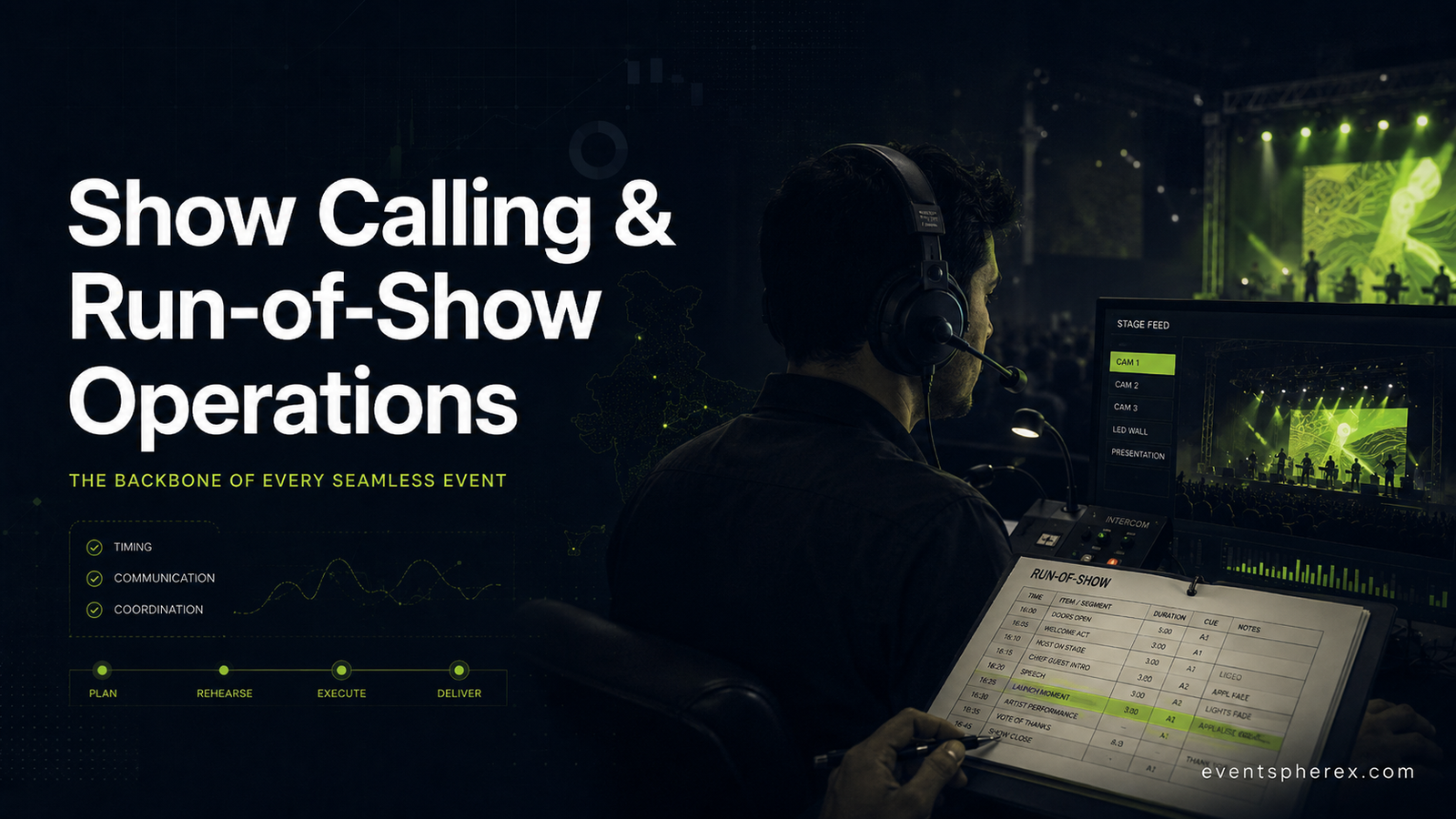
It is instructions, with timecode, with departments, with cue numbers. It is what gets read live by the show caller into headset comms while the show is running.
The single biggest reason Indian corporate events feel "loose" is that the team is running on a schedule, not on a run-of-show. The schedule says when things should happen. The RoS says how they happen. Without the RoS, every transition becomes improvisation, and every department guesses.
What a Real Run-of-Show Contains
A production-grade RoS for an Indian corporate event has at minimum:
- Timecode column - start time of each cue, in HH:MM:SS
- Cue number - sequential, so the show caller can say "going to cue 47" and everyone knows where they are
- Cue type - STBY (standby), GO, FADE, HOLD, RELEASE
- Department - AV, VID (video), LX (lighting), SND (sound), STG (stage), TLNT (talent), GFX (graphics)
- Action - what the cue does
- Notes - duration, conditions, fallback if a cue fails
Bigger shows split into separate cue sheets per department, all synchronised to one master timecode controlled by the show caller.
For a typical 90-minute corporate awards show, expect 200-400 cues. For a 3-hour multi-act festival set, 800-1,500+. This is not over-engineering. It is what makes a tight show feel inevitable instead of accidental.
The Show Caller's Job Description
The show caller (sometimes called the producer-on-comms, sometimes the stage manager calling the show) is the human at the production desk reading cues live. The job is:
- Watch the stage and the clock
- Read the next cue 2-5 seconds before it fires
- Say "STANDBY [cue number, department]"
- Say "GO" the moment the cue should fire
- Track every department's confirmation ("AV ready," "video ready," "lights ready")
- Adapt when something slips - push a cue, hold a cue, skip ahead
- Communicate the new state to every department in real time
The show caller is the highest-paid, most under-recognised person on most Indian events. A great one can save a show that's falling apart. A bad one can destroy a show that was perfectly designed.
In the Indian event ecosystem, top-tier show callers earn Rs 35K-2L per show day depending on event complexity. They are also the role most agencies don't develop in-house, instead bringing in a freelance specialist for big shows.
Comms Protocol: The Discipline That Separates Pros From Amateurs
Comms (intercom systems, usually wired or wireless headsets) are the spine of a live show. The protocol matters:
The Standard Calls
- "Standby [cue]" - heads up, this cue is coming
- "Standby acknowledged" - every department confirms they're ready
- "Go" - the cue fires now
- "Hold" - pause, do not advance
- "Release" - resume from hold
- "Skip [cue]" - we're skipping this cue, jump to the next
- "Going back to [cue]" - we're rewinding (rare, used in rehearsal)
The Rules That Stop Comms Chaos
- Only the show caller calls cues. Everyone else listens. Producers, clients, designers - all silent on the cue channel.
- Departments confirm with one word. "Ready" or "copy." Not paragraphs.
- Side-bar conversations go on a separate channel. Most pro comms systems have 4+ channels for this reason.
- No swearing. Comms is a recorded, business-environment tool. Treat it like one.
- One mic at a time. If two people talk over each other, both are useless.
Indian events that don't run a clean comms protocol are immediately recognisable on site: chaos at the production desk, three people calling cues, contradictory instructions, departments fighting on headset.
Building Your First Run-of-Show: A Walk-Through
If you're producing your first event with a real RoS, here's the process:
Step 1 - Lock the Creative First
You can't write an RoS for a show that's still being designed. Get the content, talent, video assets, and music locked. Then build.
Step 2 - Build the Skeleton
Open a spreadsheet. Columns: Time, Cue #, Type, Dept, Action, Notes.
Block out the major sections:
- Pre-show ambience (audience walk-in)
- Show open
- Each segment (welcome, awards, performances, keynote, etc.)
- Show close
- Audience walk-out
Step 3 - Add Cues Per Department
Walk segment by segment. For each segment, ask: what does AV need to do? Video? Lighting? Sound? Talent? Stage crew?
Add a cue for each action. Number them sequentially. Don't worry about exact timecode yet.
Step 4 - Add Timecode
Once cues are written, lay timecode against them. Be realistic - a "10-minute speech" needs 10 minutes plus a 30-second walk-up cushion plus a 30-second exit cushion. Build cushions into your timecode. They will get used.
Step 5 - Distribute, Walk Through, Revise
Send the RoS to every department head 48 hours before tech rehearsal. Sit with them in a tech meeting and walk through cue by cue. Revise based on what they flag. Distribute the v2.
Step 6 - Tech Rehearsal
A tech rehearsal isn't a dry run with talent. It's a cue-by-cue walk-through where every department fires their cue on the show caller's call. You're testing the RoS, not the performance.
Plan for 2x the show length for tech rehearsal time. If your show is 90 minutes, tech rehearsal is 3 hours.
Step 7 - Show Day
The show caller runs the show off the locked RoS. Any last-minute changes are noted, called clearly, and updated to the master document.
When Things Slip Live: The Recovery Toolkit
Things will slip. The producer's job is to recover, not to panic.
Slip Type 1: A speaker goes long
Action: Hold the next cue. Let the show caller cushion the timecode for the next 2-3 cues. Recover by trimming a buffer slot later in the show (usually a band performance or a video play).
Slip Type 2: A video doesn't play
Action: Hold. Show caller calls "STBY backup roll." The talent on stage gets a cue from the producer to vamp ("while we get this back up..."). AV/video resolves the issue, show caller resumes. Never go silent live.
Slip Type 3: Talent doesn't show
Action: Skip the segment. Show caller calls "skipping cues 47 through 53, going to cue 54." Every department adjusts. The MC bridges with a pre-prepared filler line.
Slip Type 4: Power / tech failure
Action: This is the hard one. Show caller calls "HOLD ALL CUES." Producer takes the room - usually via the MC - and either continues with manual / acoustic delivery or briefly pauses the audience. Never break character; never blame; always reassure.
Slip Type 5: A cue fires wrong
Action: Recover. Don't dwell. The audience usually doesn't know it was wrong. Show caller resumes the master sequence and adapts on the fly.
The discipline is: stay on comms, stay calm, stay specific. "Going to cue 51" is useful. "Oh god what's happening" is not.
Building Show Calling as a Career
If you want to become a show caller in Indian events:
- Start as an assistant on real shows. Sit on comms and listen. The protocol is learned by hearing, not reading.
- Learn one platform deeply. QLab, ShowCue Systems, or a specific console workflow. Pick one and master it.
- Build relationships with 4-5 production agencies. Show callers are usually freelance and book through agencies.
- Watch big shows. Attend or work tech-side at major Indian and international shows when you can. The pacing of a great show caller is learnable by exposure.
- Get tested on bigger formats. Awards shows, festivals, broadcast events all stretch you in different directions.
A serious show caller in 2026 with 5+ years of experience can earn Rs 15-40L a year, work selectively, and build a reputation that books them years in advance.
Closing Note
Show calling is the most invisible critical role in event production. The audience never sees it. The client rarely thanks for it. Most agencies don't even know they need it until they've seen a show without one and a show with one and felt the difference.
If you are running an Indian event agency and your shows still run off Word-document schedules, the single highest-leverage upgrade you can make in 2026 is to introduce a real RoS process. Hire (or develop) a show caller. Build cue sheets. Run real tech rehearsals. Watch your show quality jump in one event cycle.
Plan your stage layouts, cue positions, and crew placements with our free Stage Layout Planner - built for Indian event production teams.