Why a 5-Year Map and Not "Hustle Your Way Up"
Indian event careers tend to be told as personality stories. "I worked hard, I got noticed, I got promoted." That's true for the people telling the story. It is not a transferable career plan.
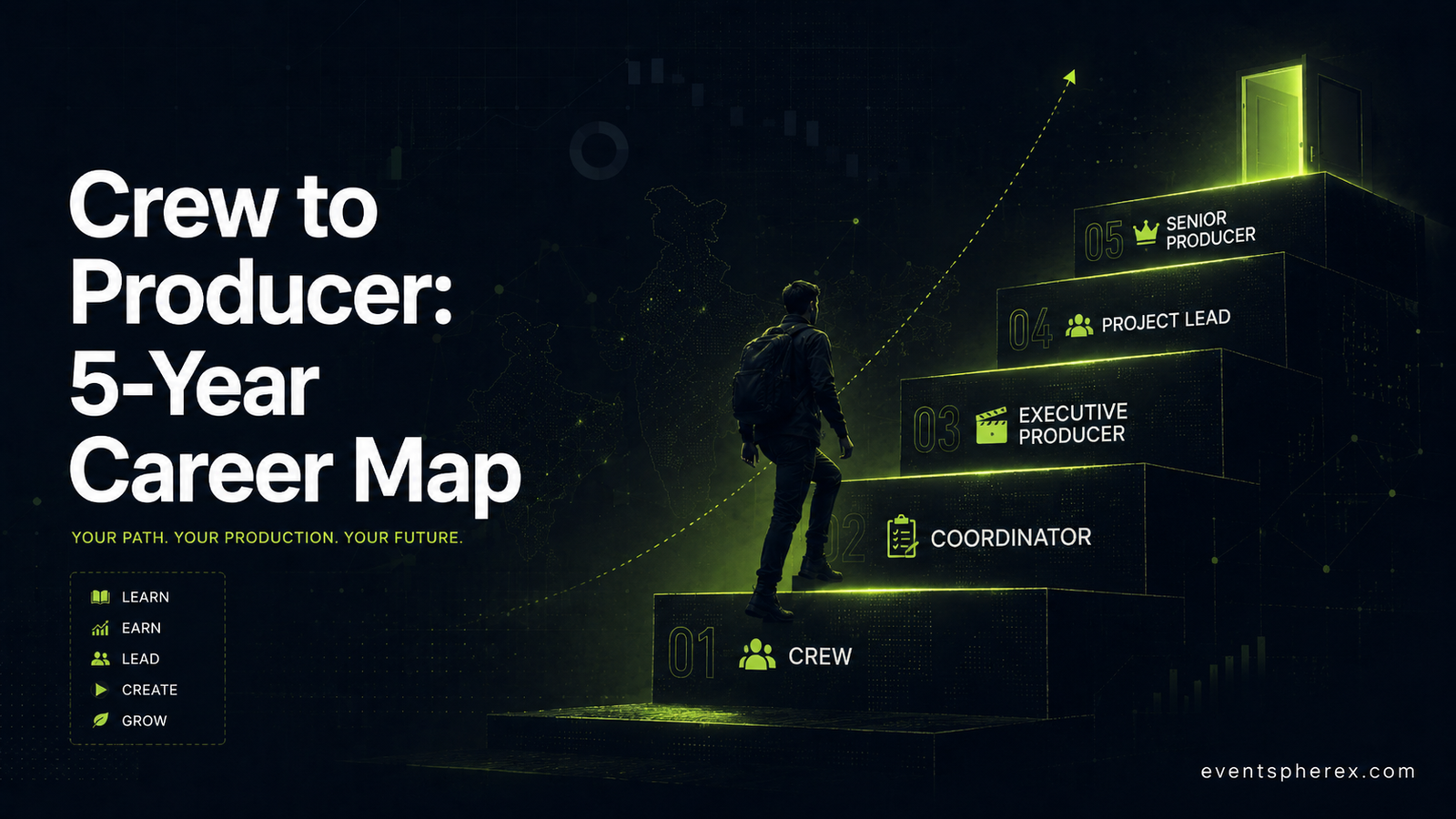
The producers who actually run major events - the ones managing Rs 2Cr+ budgets and 50-person crews - followed a recognisable skill stack. Not the same exact path, but the same rough sequence: craft -> coordination -> ownership -> leadership -> senior leadership.
Skipping a stage doesn't speed the career; it stalls it. Coordinators who try to act as producers without mastering coordination break under the load. Producers who never did real coordinator work can't troubleshoot when their team breaks down because they don't actually know what good looks like.
Five years is the realistic timeline for crew to producer if you're deliberate. Less, and you're getting promoted past your skill. More, and you're plateauing.
Year 1 - Master Your Craft
Role title: Crew, Junior Executive, Trainee Coordinator Typical salary in India: Rs 2.5L - Rs 4.5L per year (full-time) | Rs 500-1,500 per day (freelance crew)
The single biggest mistake first-year event professionals make is trying to be generalists too early. The fastest career compounds when you spend Year 1 going deep on one of:
- Decor / fabrication / props
- AV (lighting, sound, video)
- Hospitality / delegate management
- Content / scripting / show flow
- Talent management / artist liaison
Pick one. Become the team's go-to for that craft. Learn the tools, the vendors, the language, the standards.
In parallel, learn the universal skills:
- Show-floor discipline - how to behave on site, comms etiquette, time management
- Documentation - every brief, every change, every confirmation in writing
- Vendor manners - how to talk to a sound engineer, an electrician, a fabricator without being an annoyance
- Listening - most of what you need to know, you'll hear from senior producers if you're paying attention
What to avoid in Year 1: trying to be the most visible person, jumping between agencies, accepting freelance gigs you can't deliver to standard. Build a reputation for being reliable. That's the foundation of everything later.
Year 2 - Become a Coordinator
Role title: Coordinator, Project Executive, Junior Producer Typical salary in India: Rs 4.5L - Rs 8L per year
In Year 2, you stop being someone who executes parts of an event and start being someone who coordinates parts of an event end-to-end.
Owning a slice means:
- Managing 1-3 vendors directly
- Owning a budget line (decor, or AV, or hospitality)
- Reporting status to the producer or project lead
- Making small decisions without escalating
What to learn in Year 2:
- Reading and writing real briefs
- Quoting - getting 3 quotes, comparing them, recommending one with reasoning
- Vendor onboarding - KYC, contracts, advances, payment cycles
- Site recces - what to look for, what to flag
- Run-of-show - how to read one and execute against it on site
What to avoid in Year 2: skipping detail in pursuit of "thinking strategic." Year 2 is the most important detail-mastery year of your career. The producers who skip it are the ones who get caught later because they don't know what should cost what.
Year 3 - Executive Producer / Project Lead
Role title: Executive Producer, Project Lead, Senior Coordinator Typical salary in India: Rs 8L - Rs 14L per year
In Year 3, you start to own full events - under a senior producer, but with you as the day-to-day owner. The shift is:
- You are the single point of accountability for the event delivery
- You build the project plan, run the kickoff, manage the timeline
- You manage the full budget (typically Rs 15L - Rs 2Cr at this level)
- You handle client communication on operational matters
- You brief and lead the on-site team
What to learn in Year 3:
- Budgeting - building real budgets, tracking actuals against them, defending variances
- Client communication - managing expectations, written status updates, meeting agendas
- Risk management - anticipating what might go wrong, building in contingencies
- Crew management - leading a team of 5-15 on site
- Vendor negotiation - beyond getting quotes, you're now negotiating terms
- Crisis recovery - when things go wrong, you call the recovery
This is the year most professionals either step up to producer or get stuck. The ones who get stuck usually share one trait: they're great at execution but uncomfortable with making decisions under uncertainty. The fix is reps. Take the decisions. Be wrong sometimes. Learn.
Year 4 - Producer
Role title: Producer, Senior Producer, Account Lead Typical salary in India: Rs 14L - Rs 25L per year
By Year 4, you're running events as the producer - owning client relationships, leading teams, delivering events with budgets in the Rs 50L - Rs 5Cr range.
The producer-level skills:
- Client relationship ownership. You're the person the client calls. You're the producer who builds the trust that gets you re-booked.
- Pitch leadership. You contribute to or lead pitches. You can defend a pricing decision in the room.
- Budget mastery. You can build a Rs 2Cr budget from a brief in 4 hours, defend every line, and deliver to it.
- Team leadership. You hire, develop, and direct coordinators and crew. People want to work on your shows.
- Vendor strategy. You have a personal vendor network of 30-50 people across categories.
- Creative judgement. You can review creative work and give specific, useful feedback.
- On-site command. You can run a load-in, a tech rehearsal, and a live show with calm authority.
What to avoid in Year 4: getting comfortable. The middle of the producer track is where careers stagnate. Keep learning. Keep stretching into bigger or different formats.
Year 5 - Senior Producer / Specialist
Role title: Senior Producer, Specialist Producer, Account Director, Partner Typical salary in India: Rs 22L - Rs 50L per year (and rising sharply with seniority and IP)
By Year 5, the strongest producers split into one of two paths:
Path A: Senior Producer / Account Director
You manage multiple events in parallel, lead 2-3 producers under you, own large client relationships (Rs 2Cr+ annual contracts), and contribute to agency strategy. The path forward from here is partner / equity / leadership.
Path B: Specialist Producer / IP Owner
You become the agency's go-to for one type of event - luxury weddings, healthcare conferences, festivals, broadcast events, brand experiences. You command premium fees because you own a category. The path forward is freelance specialist or starting your own niche agency.
Both paths are valid. Pick based on what energises you - generalist leadership or deep category mastery.
What Compounds (and What Doesn't)
Things that compound:
- Vendor relationships. A producer with 50 strong vendor relationships is fundamentally more valuable than one with 5.
- Client relationships. Repeat clients are the highest-margin business. Build them deliberately.
- A documented portfolio. Photos, videos, case studies of every event you delivered.
- A specialty. Five years of luxury weddings or five years of healthcare conferences makes you irreplaceable in that lane.
- A reputation for honesty. The producer who tells the client the bad news early is the one who gets the call for the next event.
Things that don't compound (or that actively hurt the career):
- Job-hopping every 12 months - relationships need 18-36 months to compound
- Generalism without specialisation - being "okay at everything" doesn't pay premium fees
- Burning vendors - the vendor you screwed in Year 2 is the vendor whose sister is now the procurement head
- Overpromising, under-delivering - kills repeat business faster than anything
Salary vs Freelance Math
Most Indian event careers move between salaried and freelance at different stages.
- Years 1-3: salaried gives you reps, reviews, and structured learning. Freelance is risky here unless you're already specialised.
- Years 3-5: hybrid - salaried base with freelance project income on weekends - works well for many.
- Years 5+: senior producers can command higher gross income as freelance specialists, but lose benefits, structure, and team. The math depends on what you value.
There is no universally right answer. The wrong answer is going freelance too early because you wanted "freedom" and discovering you didn't have the network or specialisation to sustain it.
A Reality Check
Not everyone who starts as crew reaches producer. About 30-40% of entry-level event professionals leave the industry within 3 years - usually for marketing roles, hospitality management, or completely different sectors. That's not failure; events are demanding and not for everyone.
Of those who stay, maybe half reach producer-level within 5-7 years. The other half plateau as senior coordinators or specialist crew, often very capable in their craft but not climbing into ownership of full events.
The difference between the two groups is rarely talent. It's almost always:
- Did they take ownership of decisions early?
- Did they build vendor and client relationships, not just complete tasks?
- Did they specialise enough to be valuable, not so narrowly they got typecast?
- Did they document their work?
- Did they protect their health and relationships enough to stay 5+ years?
Closing Note
A producer career in Indian events is one of the most demanding, most varied, most rewarding paths available in the country's services economy. The people who reach it deliberately - through real skill stacking - are the ones who own decade-long careers, not just five-year ones.
Wherever you are on the map right now, the move is the same: master the current stage, then stretch into the next. Don't skip. Don't drift. Document what you do. Build the relationships. The career compounds.
Browse open event-industry roles at agencies hiring across India on the EventSphereX Job Board.