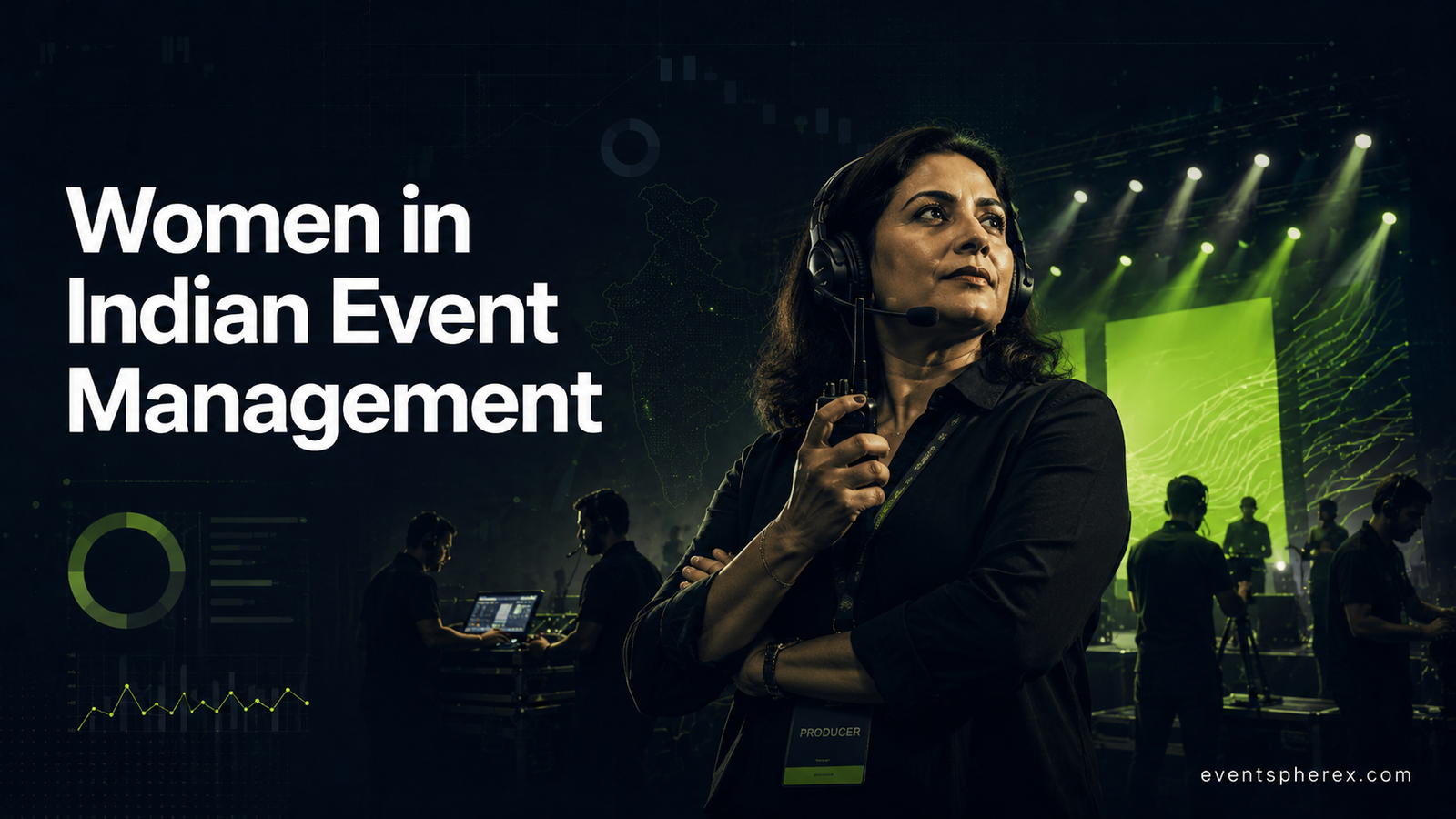
A Sector Where Women Are Visible Early - and Less Visible Later
Walk into any Indian event agency and the entry-level and mid-level rooms are 40-50% women. Walk into the senior production review meeting and that drops to 10-15%. Walk into the founder's office or the partner-track promotion list and it drops further.
This pattern is not unique to events - it shows up across Indian services industries - but the event-industry version has its own dynamics. Three of them in particular:
- The late-night production penalty. A career arc that requires being on-site at 3 AM load-ins and post-event load-outs creates a structural disadvantage for women navigating safety, family expectations, or caregiving roles.
- The freelance / project-pay system. Without formal employment, women lose access to maternity benefits, predictable income, and structured promotion paths.
- A male-dominated vendor ecosystem. AV crews, fabrication teams, security crews, and on-site labour vendors are 90%+ male - making senior on-site leadership for women a harder navigation.
None of these are individual fault. All of them are addressable.
Where Women Are Concentrated in Indian Events
Based on industry observation and informal HR data shared by agency partners, women are concentrated in:
- Client servicing / account management - frequently 50-60% women at the mid level
- Planning / production coordination - 40-55%
- Creative / design / content - 45-60%
- Hospitality / delegate management - 60-75% (often a near-majority)
- Wedding planning ownership - significant female founder representation
- Marketing / business development - 45-55%
Women are under-represented in:
- Senior production / show calling - 10-20%
- AV / lighting / technical departments - under 10%
- Operations leadership at agencies - 15-25%
- Founder / partner / equity-bearing roles at large agencies - 10-15%
The wedding industry is the one segment with notable female ownership at the top - partly because the sector grew organically through individual planners building their own studios, with fewer institutional gatekeepers.
The Pay Gap, More Honestly
The simple version of the pay gap conversation ("women earn X% less than men") hides what's actually happening:
- At junior levels (0-3 years), the gap is modest - typically 5-10% on like-for-like roles
- At mid levels (3-7 years), the gap widens to 10-18%, partly because of role differentiation (women clustered in lower-rate-card categories)
- At senior levels (8+ years), the gap can be 25-40% - driven not by same-role pay differences but by which roles women hold
In other words, the gap is not primarily "men and women paid differently for the same work." It is "men disproportionately occupy the highest-paid roles, and that pattern compounds." Both are problems. The latter is the bigger one.
Structural Barriers Worth Naming
1. Late-night production cycles
Standard event delivery includes 2 AM load-ins, post-event 4 AM load-outs, and 16-hour show days. For women, this can intersect with:
- Personal safety logistics (transport, on-site facilities, security on the floor)
- Family expectations
- Caregiving roles
Agencies that don't build the infrastructure for safe, dignified late-night work - late-night cab vouchers, women's-only on-site facilities, paired-team policies, security walk-throughs - implicitly filter women out of production roles.
2. Maternity & re-entry
Most event-industry women operate on freelance/project contracts. There is no statutory maternity benefit on a project contract.
Even on full-time roles, the 26-week Maternity Benefit Act compliance is uneven across smaller agencies. Re-entry after a maternity break is hard - the industry runs on "current relationships" and 6-9 months out of the loop costs roles.
3. The vendor ecosystem
Men in production have decade-long relationships with AV, sound, decor, and labour vendors. New senior women entering production have to build those relationships from cold. This is fixable - but takes intentional time and access.
4. Visibility & credit
Pitches are often presented by male founders or partners; female team members do the work but don't get the front-of-room moment. Over years, this affects who gets remembered, recommended, and head-hunted.
5. Safety on-site
For some on-site roles, especially at large outdoor festivals or exhibition load-ins with mixed labour crews, safety considerations are real and need to be addressed by agency leadership - not made the woman's individual problem.
What's Working - Concrete Practices
A small but growing set of Indian agencies have adopted practices that are working:
- Co-led pitches - every senior pitch is presented by both a male and a female senior, by policy
- On-site safety SOPs - paired teams after 10 PM, dedicated transport, women-only restroom and changing facilities, lit walkways, security awareness briefings before every event
- Paid maternity - full 26 weeks paid for full-time staff plus a 3-month re-onboarding plan
- Freelancer benefits - agencies pooling to provide group health insurance and accident cover for regular freelancers
- Mentor-pair systems - pairing every female team member with a senior mentor (male or female) outside their reporting line
- Vendor relationship sharing - explicitly inviting women on the team to lead vendor meetings and build direct relationships
- Speaking and showreel investment - funding women team members for industry events, panels, conference speaking - visibility compounds
None of this is exotic. It is just deliberate.
What Individuals Can Do
If you are a woman building a career in Indian events, the single highest-leverage moves:
- Specialise. Generalist careers are harder for women in this industry because they require the broadest network. Specialise in a category - luxury weddings, healthcare conferences, brand experiences, festival production, content creation - where deep expertise compounds faster than networks.
- Build vendor relationships directly. Don't let a male colleague always handle vendor calls. Even if it's slower at first, you need your own AV, decor, and venue relationships.
- Speak publicly. Industry panels, conference talks, even LinkedIn writing. Visibility from outside the agency creates leverage inside it.
- Document outcomes. A portfolio of "events I delivered, what they achieved" is the single most under-built asset in this industry. Build yours.
- Find a peer group. 5-10 women at a similar career stage, who you can swap rate cards with, vent to, and compare notes. The isolation in mid-career is real; community is the fix.
- Pick agencies that practice what they preach. Talk to women already there. The published policy and the lived reality often differ.
What Agency Founders and Senior Leaders Should Do
If you run an agency, three actions matter more than the rest:
- Audit your senior pipeline. How many of the 5-10 names that you would consider "next-level leadership" are women? If the number is zero or one, the problem is upstream of any policy you have.
- Make pay transparent at role level. You don't have to publish individual salaries, but you should be able to say "the band for senior producer is X-Y, here's how we decide where someone lands." Opacity protects bias.
- Sponsor, don't just mentor. Mentorship is advice. Sponsorship is putting your political weight behind someone - recommending them for a stretch role, putting them in front of a key client, defending them in a senior meeting. The senior women in this industry today were almost all sponsored by someone with leverage.
The Long Arc
The Indian event industry over the next decade will have more women in senior production, more women founding agencies, and more women in vendor leadership. This will happen because the talent is already there - the structural fixes are what determine whether it happens in 5 years or 15.
Faster is better for the industry. Diverse senior teams pitch better, deliver more nuanced work, build broader client relationships, and make fewer of the cultural mistakes that cost long-term contracts.
If you are reading this as a woman in Indian events: keep going. Specialise. Build your direct relationships. Find your peer group. Document everything. The industry is more open in 2026 than it has been at any point - and your career compounds with each year you stay in.
If you are reading this as an agency owner: the next senior leader you'll be glad you developed in 2027 is probably already on your team. Notice them. Sponsor them. Pay them fairly. The work follows.
Browse open roles at Indian event agencies on the EventSphereX Job Board, or list yourself in the Industry Directory to be discovered for freelance projects.