Why Most Indian Event Agencies Don't Have SOPs (and Why They Should)
The Indian event industry has a strong founder-energy culture. Most agencies grow because one or two people are exceptional at their craft, build relationships, and deliver work the team improvises into existence around them.
This is fine until growth gets serious. Then three things start to break:
- The founder is in every decision. Every WhatsApp escalates to them. They review every pitch. They take the senior client calls. The team can't move without them.
- Quality drifts between events. One project goes brilliantly. The next one - same team, same client type, different lead - is rough. There's no shared standard.
- The agency is unsellable. Most large event agencies fail to exit because nothing exists outside the founder's head. No buyer can take over a business that runs on personal memory.
SOPs and playbooks fix all three. They aren't bureaucracy. They are the operating system of a real business.
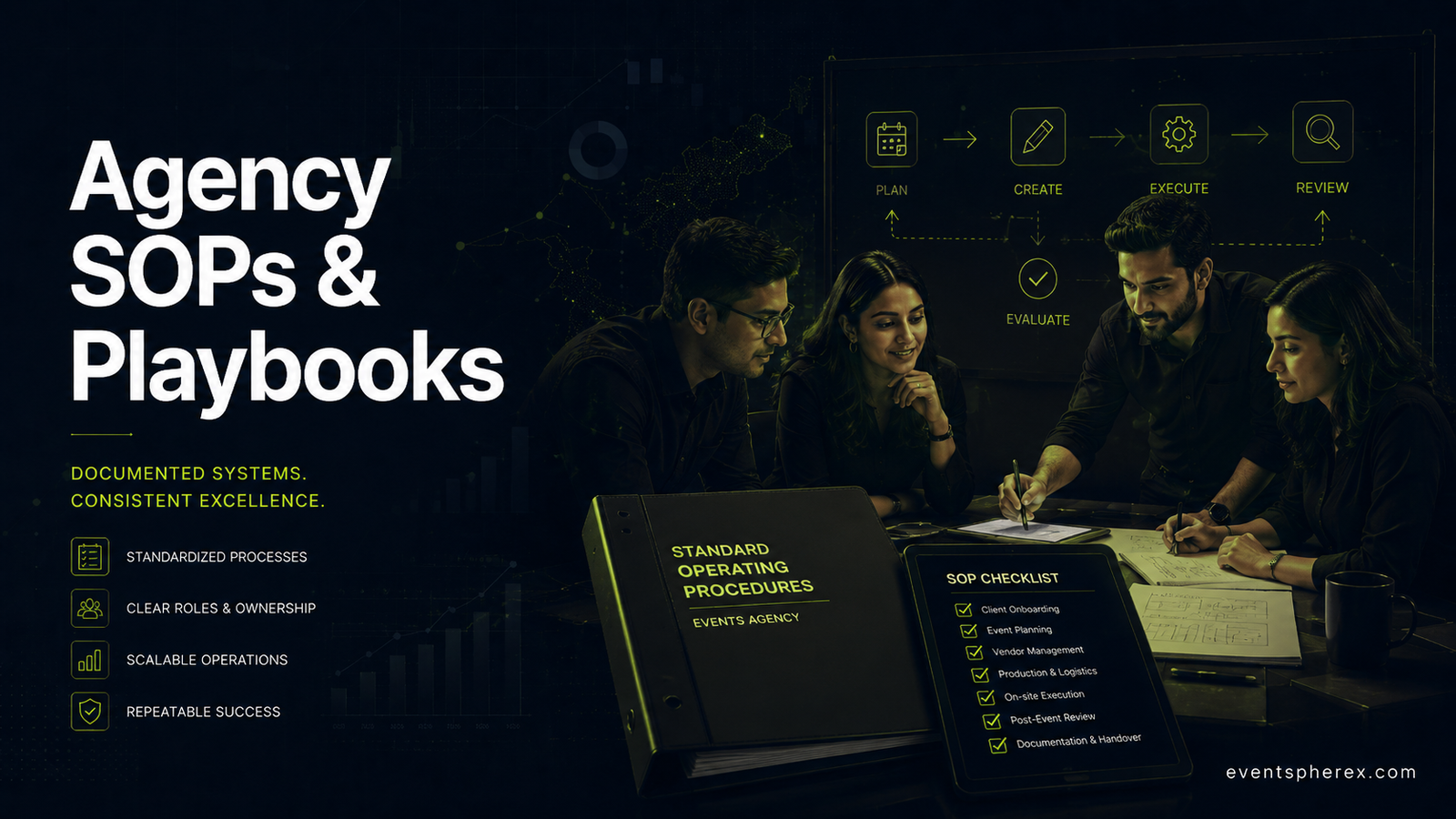
The Five Playbooks Every Indian Event Agency Should Have
You don't need 50 SOPs. You need five playbooks that cover the full lifecycle of a project. Each one short, practical, and used.
1. The Pitch Playbook
What it covers:
- Brief intake checklist - what we collect from the client before quoting
- Pre-pitch research process (4-6 hours, structured)
- Deck template and the 12-slide structure
- Pricing methodology (line-item structure, tier framework)
- Proposal generation - who writes what
- Pitch meeting conduct - who's in the room, who speaks when
- Follow-up rhythm (14-day standard)
- Win/loss tracking (every pitch, post-mortem)
This is the single highest-leverage playbook to write first. It directly affects revenue.
2. The Project Management Playbook
What it covers:
- Kickoff process - first 7 days after the PO is signed
- Project plan template (milestones, dependencies, owners)
- Weekly client review structure
- Internal stand-up cadence (daily for big events, twice-weekly for mid)
- Budget tracking - who owns it, when it's reviewed
- Risk register format (top 5 risks, mitigation, owner)
- Change-order protocol (every scope change written and signed)
- Documentation protocol - what gets stored where
A good project-management playbook is what stops "everyone working hard and nobody knowing what's happening."
3. The Vendor Playbook
What it covers:
- Vendor categories and how we segment them (preferred / approved / new)
- Onboarding checklist - KYC, GST, MSME, references, sample invoices
- Rate card collection - how we maintain category rate cards
- Quote comparison process - minimum 3 quotes for jobs above Rs 1L
- Contract template per vendor category (AV, decor, catering, fabrication, transport)
- Payment terms standard (50%/30%/20% for new vendors; 30%/40%/30% for preferred)
- Performance review - every vendor scored after every event
- Blacklisting protocol - when and why we stop working with a vendor
A real vendor playbook is the asset most agencies underestimate. It compounds - every event, you build smarter contracts and tighter relationships.
4. The On-Site Delivery Playbook
What it covers:
- T-30 day, T-7 day, T-2 day, T-0 checklists
- Run-of-show template
- Crew briefing protocol (every event, before load-in)
- Comms protocol (channel structure, escalation path)
- On-site reporting cadence - what producer reports back to office, when
- Incident management - what to do when something goes wrong
- Wrap protocol - load-out, returns, debrief, photos, client thank-you
- Post-event report template (what worked, what didn't, what to change)
This is the playbook that turns "every event feels different" into a repeatable delivery rhythm.
5. The Finance Playbook
What it covers:
- Quote -> Invoice -> Receivable -> GST flow
- Approval matrix (what spend levels need what sign-off)
- Petty cash handling on site
- TDS and GST compliance steps per event
- Receivables follow-up rhythm (T+15, T+30, T+45, T+60)
- Vendor payment release process
- Monthly P&L by project (every event, profit-tracked)
Money is the area most under-documented at Indian agencies. A clean finance playbook is the difference between an agency that scales and one that perpetually feels broke even when revenue is up.
What Goes Inside a Playbook (Format That Works)
For each playbook:
- Cover page - what the playbook covers, who owns it, last updated date
- Section 1: Purpose - why this exists, what problem it solves
- Section 2: Roles - who does what (RACI matrix is fine; named roles are better)
- Section 3: Process - step-by-step, with timeframes
- Section 4: Templates - embed or link to actual templates (deck, project plan, RoS, contract)
- Section 5: Checklists - printable/scannable checklists for the team to use live
- Section 6: Common mistakes - short, named, with the fix
- Section 7: Versioning - when this was last updated, what changed
A good playbook is 8-20 pages. Not 80. People only use what they can read in one sitting.
How to Actually Roll Them Out (Without Them Becoming Shelf Documents)
The SOP graveyard at most Indian agencies is huge. Documents written, never used. Three rules:
1. Write Them With the Team, Not For the Team
The producer who runs your shows should co-write the on-site delivery playbook. The accounts head should co-write the finance playbook. People follow what they helped build; they ignore what's handed to them.
2. Build Them Into the Real Workflow
A playbook that's a PDF in a Drive folder is dead. A playbook that's:
- The kickoff template in your project management tool (ClickUp, Notion, Asana)
- The fields in your CRM
- The line items on your invoice
- The checklist on the on-site producer's tablet
...is alive. The playbook is the workflow.
3. Review and Update Quarterly
After every event, the team flags one thing the playbook should do better. Once a quarter, the founder or COO updates each playbook based on those flags. A playbook that hasn't been updated in 12 months is no longer the playbook your team actually runs.
The Founder's Real Test
A good test of whether your agency has real SOPs: Can you take a 14-day holiday with no laptop, no WhatsApp, and the agency delivers an event during that window without you?
Most Indian agency founders cannot. The fix is not "trusting the team more." It is documenting the system so the team has something to operate against.
When you can leave for two weeks and come back to a clean delivery, three happy clients, and a project that ran on budget - your playbooks are real. Until then, they're aspirational.
Common SOP Mistakes
- Too detailed. A 60-page document nobody reads. Keep it 10-20 pages.
- Too generic. "Be professional with vendors." Useless. Specific instructions, named owners, named templates.
- No templates. A process without a template is just a wish. Every step that produces an artefact should link to the artefact template.
- Not embedded in tools. A PDF in Drive is a museum piece. The playbook needs to live in the tools the team uses every day.
- Written by the founder alone. Adopted by no one.
Closing Note
The Indian event industry has hundreds of brilliant founders running agencies that plateau because nothing scales. The agencies that break through Rs 10Cr, Rs 25Cr, Rs 50Cr+ in revenue are not always the ones with the most creative talent. They are the ones with documented systems that let great delivery happen even when the founder is on vacation.
Start with the pitch playbook. Get it written, tested, and used. Move to project management next. Then vendors, on-site, finance. Each one takes 2-4 weeks to do well. Six months in, you'll have a different agency.
It is one of the most boring, highest-leverage moves a founder can make. Most never make it. The ones who do compound for the next decade.
Plan, budget, and execute your next event with our free tools - Event Budget Calculator, Stage Layout Planner, and Industry Directory.